
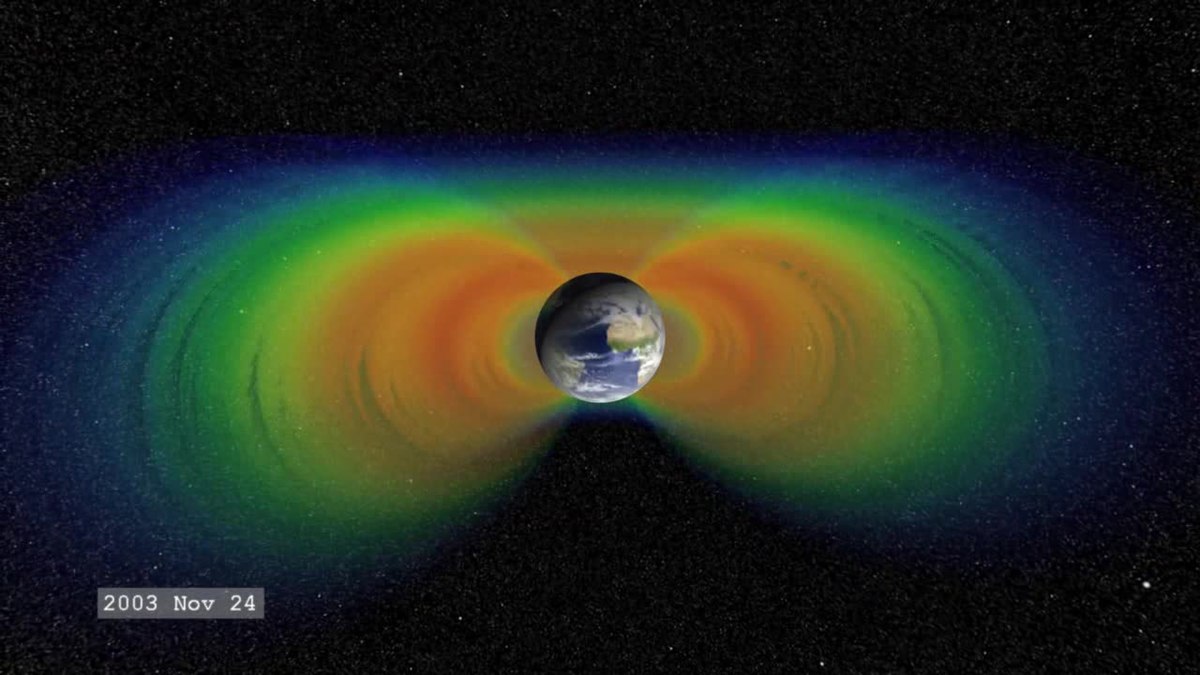
A strong geomagnetic storm in May 2024 caused Earth to develop two unprecedented radiation belts, including a unique proton-dominated belt that may still exist, according to reports from NASA’s Colorado Inner Radiation Belt Experiment (CIRBE) satellite. These belts challenge our understanding of magnetospheric dynamics and raise concerns for space travel and satellite operations.
New Radiation Belt Formation
Two remarkable radiation bands were created between Earth’s permanent Van Allen belts as a result of the May 2024 geomagnetic storm, which was the strongest in 21 years. These new belts included the following:
An electron belt at L=2.5-3.5 with 1.3-5 MeV electrons
At L=23, a proton belt with 6.8–20 MeV protons
The electron belt was exceptionally protracted, remaining in place for more than three months as opposed to the average four weeks. In addition to disrupting GPS and causing broad aurora displays, this extraordinary event called into question accepted hypotheses about the dynamics of the radiation belt, namely those pertaining to the creation and stability of transient bands.
Distinctive Properties Of The Proton Belt
In contrast to the usual transient radiation belts made entirely of electrons, the proton belt found during the May 2024 solar storm was remarkably stable. This special characteristic casts doubt on current radiation belt dynamics theories and could have a lasting impact on our comprehension of magnetospheric processes. Extreme solar events may produce more intricate and durable structures in Earth’s near-space environment than previously believed, as evidenced by the proton belt’s peculiar composition and durability.
REPTile-2 And CIRBE Satellite
In June 2024, NASA’s Colorado Inner Radiation Belt Experiment (CIRBE) satellite was accidentally reactivated after going silent owing to a technical issue in mid-April, which allowed for the detection of the new radiation belts. The complex Relativistic Electron Proton Telescope integrated tiny experiment-2 (REPTile-2) is carried by the satellite. It is a miniature device that includes:
For electron measurements, there are 60 energy channels (0.25-6 MeV).
Sophisticated guard rings to stop contamination.
High-energy resolution using Pulse Height Analysis (PHA).
With the use of this advanced equipment, the freshly formed radiation belts could be measured in great detail, yielding hitherto unheard-of information about their makeup and behavior. The ability of the REPTile-2 was essential in identifying the distinctive features of the proton belt, a finding that has important ramifications for our comprehension of how the Earth’s magnetosphere reacts to severe solar flares.
Space Technology Consequences
The technology and operations of space will be significantly impacted by the finding of these new radiation belts. These unexpected high-energy particle environments now pose a risk to spacecraft launching into geostationary orbits, requiring a reassessment of orbital and shielding techniques. These belts provide further risks to astronauts on space missions, especially for those going beyond low Earth orbit. Concerns over long-term impacts on satellite operations and space-based communications systems are also raised by the electron belt’s duration and the proton belt’s exceptional stability. In order to better anticipate and lessen the effects of upcoming intense solar events on our increasingly space-dependent technologies, our findings highlight the necessity of ongoing monitoring and enhanced modeling of Earth’s magnetosphere.