
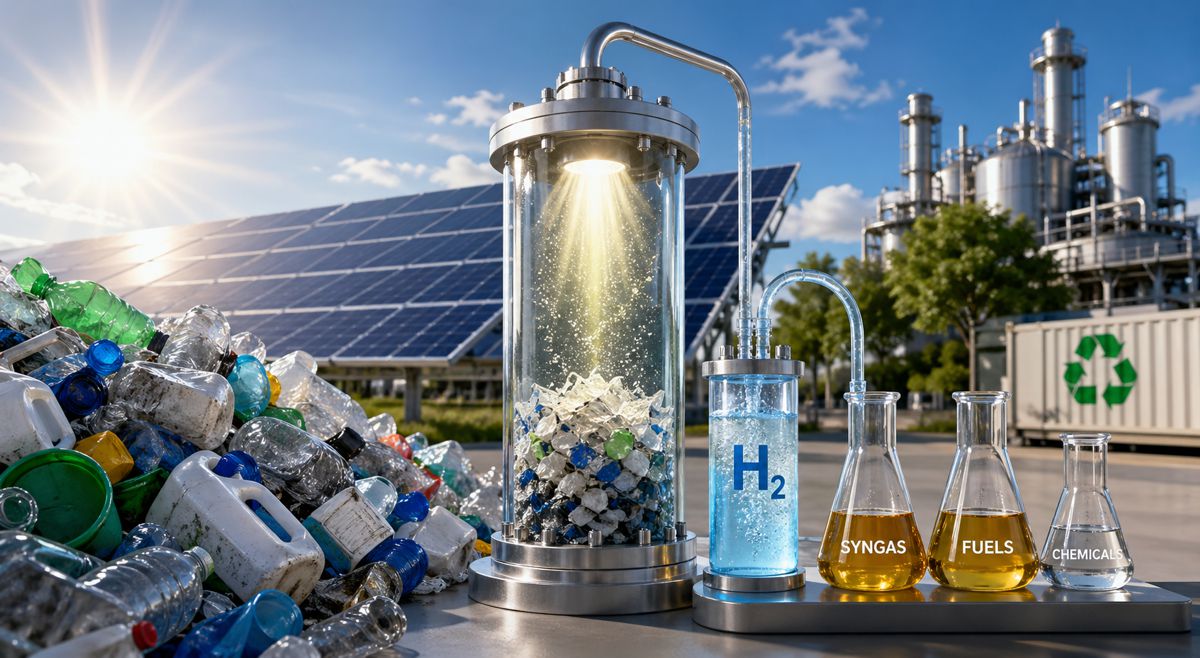
Adelaide University researchers have developed a plan for utilizing sunlight to turn plastic waste into hydrogen and other clean fuels, potentially addressing pollution and energy issues at the same time.
The study, which was published this week in the journal Chem Catalysis, looks at how a process called solar-driven photoreforming breaks down plastics at relatively low temperatures using light-activated materials called photocatalysts, producing syngas, acetic acid, diesel-range hydrocarbons, and hydrogen, a fuel with no emissions.
A Twofold Approach To Energy And Pollution
Millions of the more than 460 million tonnes of plastic that are generated annually leach into the environment. The Adelaide team, headed by PhD candidate Xiao Lu and senior author Professor Xiaoguang Duan, contends that plastics, which are high in carbon and hydrogen, are not just waste but rather an unexplored energy source. Although plastic is frequently perceived as a serious environmental issue, it also offers a substantial potential, according to Lu in a university statement. “If we can efficiently convert waste plastics into clean fuels using sunlight, we can address pollution and energy challenges at the same time.”
Because plastic’s chemical bonds are easier to break, plastic-based photoreforming is more energy-efficient than traditional water splitting, which is the most popular technique for producing green hydrogen. The researchers report that some experimental systems have run nonstop for over 100 hours.
Difficulties Ahead
The technique is far from ready for industrial adoption, the researchers warn. Common additions like stabilizers and dyes can disrupt the conversion process, and different types of plastics behave differently. Over time, photocatalysts gradually deteriorate, and the conversion process results in complicated gas and liquid mixes that need energy-intensive purification. According to Duan, there is still a disconnect between achievement in the lab and practical implementation. “We need more robust catalysts and better system designs to ensure the technology is both efficient and economically viable at scale.”
The Adelaide study coincides with a different project from the University of Cambridge, which was published earlier this month in the journal Joule. In this project, researchers created a solar-powered reactor that breaks down difficult-to-recycle plastics like nylon and polyurethane into hydrogen and acetic acid using acid recovered from old car batteries. The system’s developers claim that it might provide significant cost savings over alternative photoreforming techniques, and it operated for over 260 hours without experiencing any performance loss. Professor Erwin Reisner of Cambridge stated, “We’re not promising to solve the global plastics problem.” “But this shows how waste can become a resource.”