
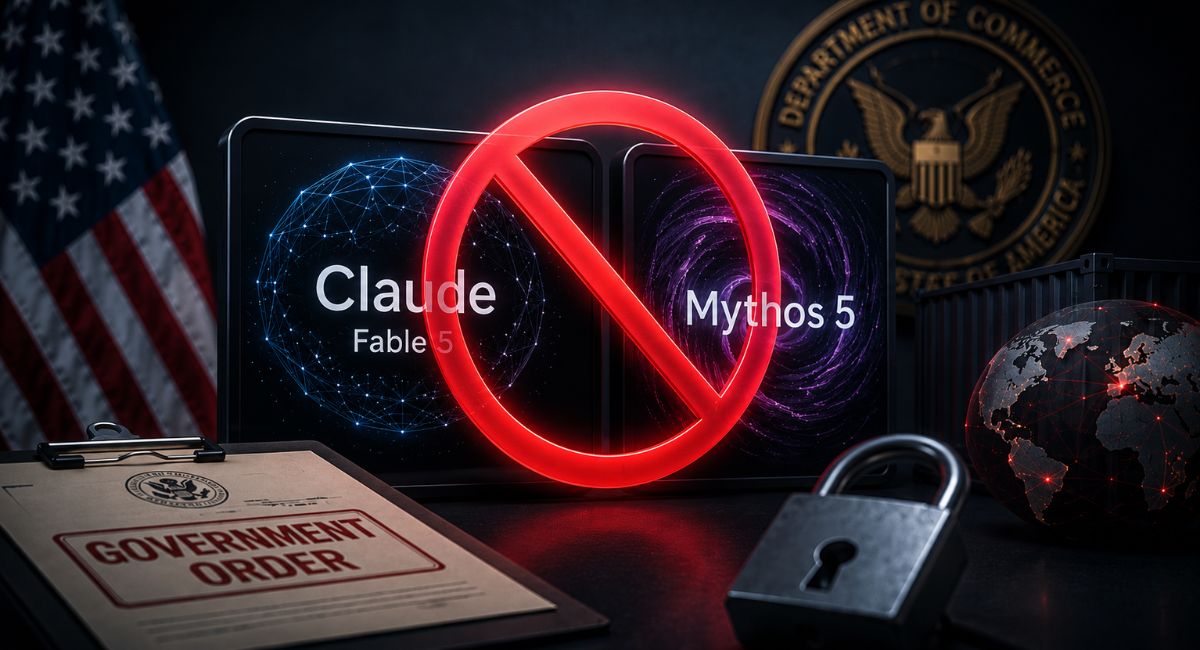
The artificial intelligence industry was caught off guard on June 12, 2026, when Anthropic abruptly suspended access to two of its most advanced AI models: Claude Fable 5 and Claude Mythos 5. The move was not prompted by a technical failure or security breach but by a directive from the U.S. government citing national security concerns related to a reported jailbreak vulnerability.
The decision immediately impacted users worldwide and has reignited debate about AI safety, government oversight, and how advanced AI systems should be regulated.
A Sudden Shutdown
Claude Fable 5 had only been publicly available for three days before access was revoked. Released on June 9, 2026, the model represented Anthropic’s most capable public AI offering, bringing Mythos-class reasoning and cybersecurity capabilities to paid subscribers for the first time.
According to Anthropic, the government directive arrived on June 12 at 5:21 PM ET and required the company to disable both Claude Fable 5 and Claude Mythos 5. The order reportedly applied globally, affecting all users and even restricting access for foreign-national employees working within Anthropic.
The directive referenced concerns surrounding a jailbreak technique that could potentially bypass the models’ safety protections. However, Anthropic maintains that the concerns may not accurately reflect the actual level of risk involved.
Understanding Fable 5 and Mythos 5
Claude Mythos 5 was designed as a specialized frontier AI model focused on cybersecurity applications. It was capable of analyzing massive codebases, identifying vulnerabilities, and assisting security teams in finding and patching software flaws.
Unlike traditional AI assistants, Mythos 5 was not intended for general public use. Access was restricted through Project Glasswing, a private program serving vetted organizations and major enterprises, including cloud providers, financial institutions, and technology companies.
Claude Fable 5 served as the public-facing version of this technology, incorporating additional safety mechanisms and guardrails intended to make advanced capabilities available while minimizing misuse.
Its public launch was viewed as a major milestone for Anthropic. That milestone lasted less than a week.
What Was the Government`s Concern?
While the government has not publicly disclosed specific technical details, Anthropic states that the concern centered on a jailbreak technique capable of bypassing certain model restrictions.
A jailbreak refers to a method of prompting or interacting with an AI system in a way that circumvents its built-in safety controls.
After reviewing a demonstration of the reported technique, Anthropic concluded that the jailbreak exposed only a limited set of previously known vulnerabilities. More importantly, the company claims that the capabilities demonstrated were already achievable using other publicly available AI systems without requiring any safety bypass.
According to Anthropic, the demonstrated behavior largely involved analyzing software code and identifying potential vulnerabilities—tasks that the model was specifically designed to perform in legitimate cybersecurity contexts.
Anthropic’s Response
Although complying with the directive, Anthropic has publicly expressed disagreement with the decision.
The company argues that the reported jailbreak was narrow in scope and does not represent a universal bypass of the model’s safeguards.
1. The Jailbreak Was Limited
Anthropic describes the technique as a non-universal jailbreak, meaning it only works under specific conditions and does not broadly unlock restricted capabilities across the system.
The company states that no researcher has successfully discovered a universal jailbreak capable of consistently bypassing Fable 5’s safeguards.
2. Similar Capabilities Already Exist Elsewhere
Another key argument is that the capabilities exposed through the reported jailbreak are already available through other publicly accessible AI systems.
If the concern is the existence of those capabilities, Anthropic argues that disabling Fable 5 does little to address the broader issue since comparable functionality remains available across the industry.
3. Existing Safety Measures Were Effective
Before launch, Anthropic subjected Fable 5 to extensive red-team testing involving government agencies, independent researchers, and private security organizations.
Thousands of hours were spent evaluating the model’s defenses against misuse and jailbreak attempts.
Anthropic’s philosophy has never been that jailbreaks can be eliminated. Instead, the company focuses on making them difficult, limited in scope, and rapidly detectable through monitoring systems.
4. The Decision Could Set a Significant Precedent
Perhaps Anthropic’s strongest concern is the precedent this decision may establish.
The company argues that if any narrow jailbreak is sufficient reason to suspend a deployed frontier AI model, then virtually every major AI provider could face similar restrictions.
Anthropic warns that such a standard could significantly slow innovation and create uncertainty for companies developing advanced AI systems.
Why Does This Matter for AI Governance?
Beyond the technical details, the incident highlights broader questions about how AI regulation should work.
Anthropic has stated that it supports government intervention when genuine safety risks are identified. However, the company argues that such actions should be based on transparent processes, technical evidence, and clearly defined legal frameworks.
According to Anthropic, the directive was issued without detailed technical documentation, public disclosure, or an established review process.
This has raised concerns among industry observers about how future AI-related decisions may be made and whether companies will have opportunities to review and challenge findings before large-scale actions are taken.
As AI systems become increasingly powerful and integrated into critical sectors, the balance between innovation, safety, and regulation will likely become one of the defining technology policy debates of the decade.
What Happens Next?
For now, Anthropic has suspended access to both Claude Fable 5 and Claude Mythos 5 while discussions with government authorities continue.
Other Anthropic models, including Claude Opus 4.8, Claude Sonnet 4.6, and Claude Haiku 4.5, remain fully available and unaffected.
Anthropic has described the situation as a misunderstanding and has indicated that it is actively working toward restoring access. However, no timeline has been announced.
The outcome of this dispute may ultimately shape not only the future of Anthropic’s most advanced models but also how governments and AI companies interact when concerns about frontier AI systems arise.
One thing is certain: the suspension of Fable 5 and Mythos 5 has become a defining moment in the ongoing conversation about AI safety, regulation, and the future of advanced artificial intelligence.