Industrial service teams are facing a convergence of pressures that is making AI, remote diagnostics, and digital knowledge systems increasingly necessary. Equipment is becoming more complex, experienced technicians are retiring, and critical service information remains scattered across disconnected systems. Together, these challenges increase cost-to-serve, suppress first-time fix rates, and make it harder for organizations to deliver consistent service outcomes.
The workforce challenge is particularly significant. According to the U.S. Census Bureau, the share of manufacturing and wholesale trade employment concentrated at firms where at least a quarter of the workforce is over 55 nearly tripled between 2000 and 2022, rising from 14% to more than 40%. This aging workforce sits behind a projected manufacturing talent shortage that the National Association of Manufacturers, citing Deloitte and The Manufacturing Institute, estimates could reach 2.1 million unfilled jobs by 2030, with a potential economic impact of $1 trillion in that year alone. In technical and engineering-intensive occupations, the U.S. Department of Energy has reported that 52% of skilled technicians and engineers may need to be replaced within the next decade.
At the same time, maintenance inefficiency continues to cost substantial amounts. Research published through the National Institute of Standards and Technology estimates that maintenance-related expenditures and preventable losses across U.S. discrete manufacturing total approximately $222 billion annually. The same research found that manufacturers relying more heavily on predictive and preventive maintenance experienced 52.7% less unplanned downtime than organizations relying primarily on reactive approaches.
The pressure to modernize is occurring alongside rapid AI adoption. Stanford HAI’s 2026 AI Index reports that organizational AI adoption has reached 88%. Yet the Institute’s 2025 research cautioned that a growing gap exists between what AI can technically accomplish and the operational discipline organizations have in place to deploy it effectively against real-world problems.
For industrial service organizations, this makes knowledge continuity, diagnostic readiness, and frontline-focused modernization increasingly important.
Emerj recently hosted Mike Hughes, Group Service Director at Peak International Group, and Scot Burdette, Global Division CIO at ABB, on the AI in Business Podcast to examine how industrial service leaders are modernizing technician enablement, knowledge continuity, and diagnostic decision-making as equipment complexity rises and experienced talent retires.
Their discussions point to four connected priorities: capturing the knowledge of retiring experts, bringing diagnostic information together, developing remote diagnostic capabilities, and sequencing modernization around the frontline problems that matter most.
Knowledge Capture Workflows for Retiring Expertise
How Industrial Service Leaders Are Closing the Knowledge Gap Before It’s Too Late
Mike Hughes begins with what he considers one of the most urgent challenges facing industrial service organizations: the accelerating loss of tacit knowledge as experienced technicians retire.
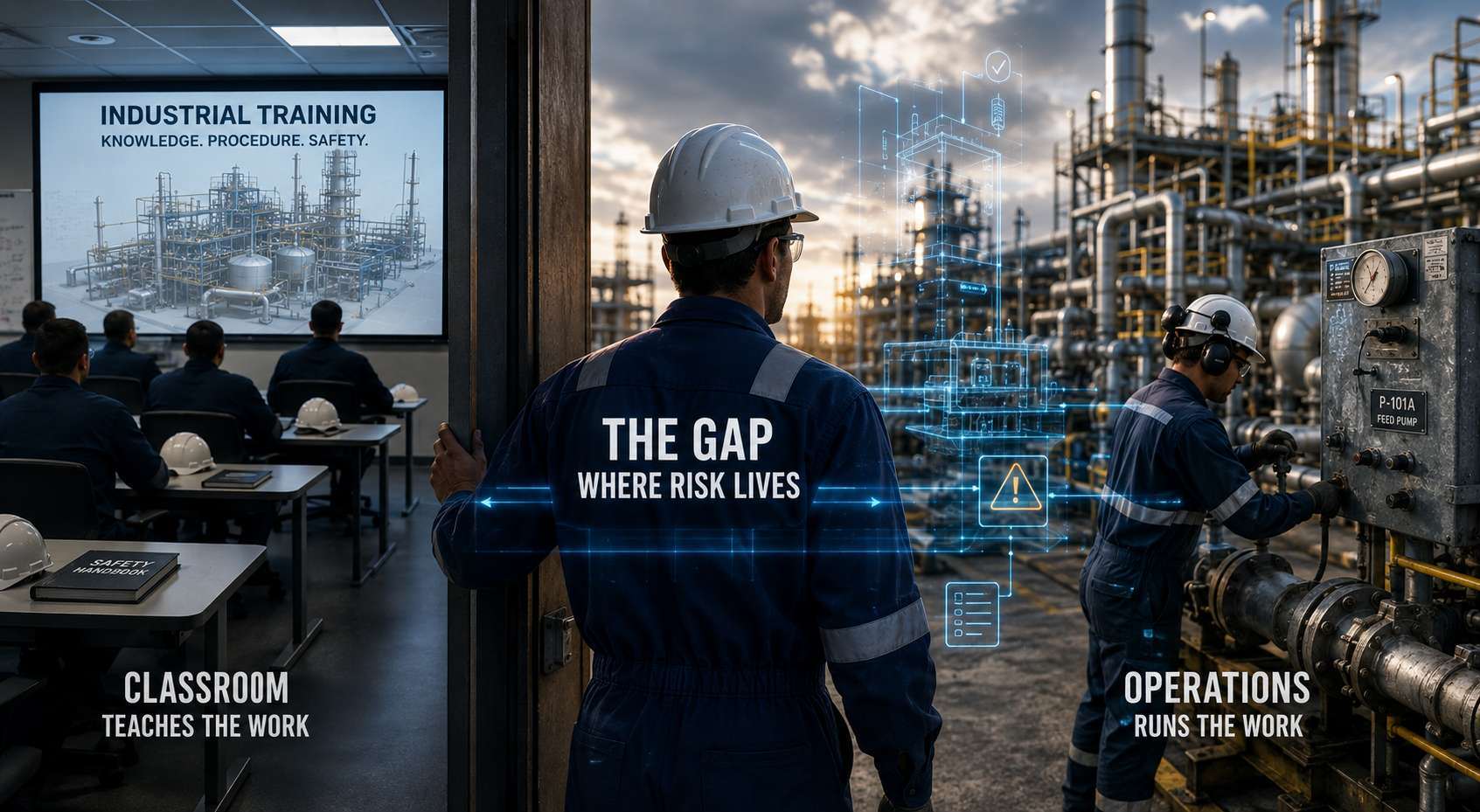
For decades, industrial service organizations have relied on technicians who accumulated knowledge through years of hands-on experience. Much of that expertise never made it into manuals or formal training materials. It exists in the memories of people who know which symptoms indicate a particular failure, which diagnostic questions to ask, and which seemingly minor signals suggest a larger equipment problem.
As those employees leave, organizations can lose an enormous amount of operational knowledge in a single retirement.
Hughes describes the challenge directly:
“The one that stands out for me in conversations is the silver tsunami — the aging workforce. In field service in particular, it’s very common to have engineers who’ve been doing the job for twenty or thirty years, and there is more information in those people’s heads than there is in all of your manuals. The next generation is not going to spend twenty or thirty years with one company, so the question becomes: how do you preserve that tacit knowledge while you still have it, and how do you speed up onboarding so an engineer with two years of experience can get close to the results you’d get from someone with twenty?”
The challenge is not simply replacing employees. It is replacing the accumulated decision-making capability that comes with decades of experience.
Scot Burdette adds another dimension to the problem. Modern industrial equipment has become sufficiently complex that knowledge transfer cannot always be reduced to a short onboarding program. Senior experts often need to work alongside incoming engineers for an extended period so that newer employees can understand the nuances of increasingly sophisticated systems.
This creates a fundamental shift in how service organizations need to think about workforce planning. Experience can no longer be allowed to disappear naturally when an employee retires. Organizations need structured mechanisms for identifying, capturing, and transferring that expertise while it is still available.
The process begins with visibility into retirement timelines and potential knowledge gaps. Organizations need to understand which technical areas depend heavily on a small number of experienced employees and where the loss of those individuals could create operational risk.
From there, companies can establish longer-term pairing between experienced technicians and newer engineers. But the objective should extend beyond traditional mentorship. The goal is to transform tacit knowledge into structured guidance that can be reused by the broader service organization.
That might include troubleshooting decision trees, diagnostic procedures, common failure patterns, service histories, escalation criteria, and explanations of why experienced technicians make particular decisions.
Knowledge continuity therefore becomes an operational capability rather than simply a human-resources initiative. When expertise directly affects troubleshooting accuracy, first-time fix rates, uptime, and customer satisfaction, preserving that knowledge becomes part of maintaining service performance.
Hughes and Burdette ultimately converge on the same conclusion: organizations need to capture critical expertise before it walks out the door. The faster experienced technicians retire, the less viable it becomes to rely on decades of individual tenure as the primary mechanism for maintaining service quality.
Unified Diagnostic Data for Faster Fault Resolution
Capturing expertise is only one part of the problem. Service organizations also need to ensure that technicians and remote experts can actually access the information required to diagnose an equipment problem.
Scot Burdette explains that remote diagnostics depend on bringing together the relevant operational information. Case histories, sensor readings, technical documentation, diagnostic signals, parts information, and service records often exist in separate systems. When experts have to move between multiple applications to understand a single equipment problem, diagnosis slows down and the probability of error increases.
The problem becomes particularly serious when an issue is rare or intermittent. A technician may need to examine historical service cases, previous alerts, technical bulletins, and equipment behavior to recognize a pattern. If those sources are scattered across multiple platforms, the information may technically exist but still be practically inaccessible.
Mike Hughes provides a concrete example of what this fragmentation looks like in practice:
“Before, when a technician needed to troubleshoot a unit, they’d review the case history in System A, refer to technical bulletins in System B, then move to System C to identify and locate the part they needed. On top of the technical debt of supporting a wide range of legacy and current products, they also have to jump across different platforms just to do their job. That fragmented experience hasn’t been great for them — we want to get to one place where everything a field engineer needs is at their fingertips.”
This kind of system hopping creates friction at exactly the moment when speed matters most.
A technician who cannot quickly determine the likely cause of a failure may need to escalate the case. A field engineer may arrive without the correct replacement part. A remote expert may lack the historical information needed to identify an intermittent fault. What begins as a data-access problem can ultimately become an avoidable truck roll, a repeat visit, extended downtime, or a failure to resolve the issue on the first attempt.
The challenge is amplified by technical debt. Industrial manufacturers often support equipment designed and sold across many years, meaning service organizations must maintain information about both legacy and current products. As product portfolios expand, documentation and service information become increasingly distributed.
A unified diagnostic environment can change that equation by bringing the relevant information into a single operational experience. Instead of forcing technicians to determine which system contains each piece of information, the service environment can surface the case history, technical guidance, parts information, equipment data, and diagnostic signals needed for the specific problem.
This does not necessarily mean every piece of data must be physically moved into one database. The more important requirement is that service professionals can access the relevant information through a unified workflow.
When that happens, diagnostic work becomes faster and more consistent. Remote teams can see the same information as field technicians, experts can recognize patterns more quickly, and dispatch decisions can be made with greater confidence.
The ultimate objective is not simply better data management. It is better service execution.
Remote Diagnostic Hubs for Scalable Expertise
As industrial equipment becomes more sophisticated, organizations cannot rely exclusively on technicians physically traveling to every machine that develops a problem. Remote diagnostics provide a way to extend scarce expertise across a much larger installed base.
Burdette emphasizes that remote diagnostic work requires a different type of expertise from traditional field service. A technician standing in front of equipment can inspect it physically, listen to its operation, observe environmental conditions, and interact directly with components. A remote specialist must derive that understanding from signals and data.
As Burdette explains:
“It is a different kind of expert. If you’re standing in front of the equipment, you can look at it and assess it hands-on — that’s very different from remote. You have to understand the right questions to ask, you have to understand what the data is telling you, and you have to be more prepared to provide that support on an ongoing basis.”
This distinction is important because remote diagnostics should not simply be treated as traditional service performed through a video call. It requires dedicated processes, tools, skills, and organizational structures.
A remote diagnostic team needs to understand equipment telemetry, identify meaningful trends, distinguish normal variations from anomalies, and determine when intervention is necessary. It must also know when a problem can be resolved remotely and when a field technician needs to be dispatched.
This creates an opportunity to centralize specialized expertise.
Instead of requiring every facility or region to maintain deep expertise across every type of equipment, organizations can establish diagnostic hubs where specialists monitor equipment signals and support technicians across a broader geographic area.
The model becomes particularly powerful when combined with continuous monitoring. Rather than waiting for a customer to report a failure or for a technician to discover an issue during a scheduled visit, remote teams can observe equipment behavior continuously and identify changes that may indicate an emerging problem.
Burdette describes the importance of having teams that can monitor trends, recognize when equipment is behaving differently, and intervene before a problem becomes more serious.
This shifts service from episodic troubleshooting toward continuous operational awareness.
It also creates a new category of service professional. Remote experts must be comfortable reasoning from data, asking targeted questions, interpreting trends, and making decisions without physically touching the equipment.
As these capabilities mature, remote diagnostic hubs can become an important foundation for predictive maintenance. Instead of simply responding to failures or following fixed maintenance schedules, service organizations can intervene based on actual equipment behavior.
The benefit is not only reduced travel. It is the ability to scale specialized expertise across a larger installed base while responding to problems earlier.
Frontline-First Sequencing for Modernization ROI
The final lesson from Hughes and Burdette is perhaps the most practical: industrial modernization should begin with the frontline rather than with technology.
Organizations frequently approach transformation by selecting a new platform, designing a large data architecture, or launching an enterprise-wide technology initiative. While these investments may eventually be necessary, they can make modernization feel distant from the people who actually experience the operational problems every day.
Hughes recommends starting somewhere much closer to the work itself.
Leaders should spend time understanding how technicians actually operate, where they lose time, which information they struggle to find, which processes create repeated effort, and why certain service calls require multiple visits.
The most valuable modernization opportunities are often visible in these everyday frustrations.
Hughes explains:
“The strongest advice I can give is start with feedback from the frontline — understand what the pain points are at the crucial end of the business. Your engineers will tell you outright, or if you spend a day in the life of one of them, you’ll see clearly where the gaps and opportunities are. Then don’t try to do everything at once — be intentional about selecting one or two use cases, because it’s easy to relate something like an avoided truck roll straight to your P&L.”
This approach creates a much clearer path to measuring return on investment.
An avoided truck roll has a tangible financial value. A higher first-time fix rate can be measured. Reduced diagnostic time can be tracked. Faster onboarding can be evaluated. These outcomes give leadership a direct connection between modernization investments and business performance.
The strategy also reduces organizational resistance.
Instead of asking employees to adopt an entirely new operating model at once, organizations can address one or two high-friction problems and demonstrate that the new approach makes their work easier.
Once employees experience that improvement, the organization has a foundation for expanding into additional use cases.
This is particularly important in industrial environments, where modernization projects must coexist with legacy equipment, established workflows, safety requirements, and highly specialized expertise.
The objective is therefore not to modernize everything simultaneously. It is to create a sequence of improvements in which each successful deployment builds credibility for the next.
Building the Next Generation of Industrial Service
The pressures facing industrial service organizations are unlikely to ease. Equipment will continue to become more complex, experienced employees will continue to retire, and service organizations will be expected to support increasingly sophisticated assets with fewer specialized people.
AI can help address these pressures, but technology alone will not solve the problem.
The conversations with Mike Hughes and Scot Burdette demonstrate that successful modernization depends on connecting technology to the realities of frontline service work.
Knowledge needs to be captured before experienced technicians leave. Diagnostic information needs to be accessible through unified workflows rather than scattered across disconnected systems. Remote diagnostic teams need to become a deliberate organizational capability rather than an informal extension of field service. And modernization efforts need to begin with measurable frontline problems instead of abstract technology objectives.
The most important shift is therefore not from manual service to AI-powered service. It is from experience trapped in individual employees and disconnected systems toward a service organization where knowledge, diagnostics, and decision-making can be shared and scaled.
For industrial organizations, that shift could determine whether they simply manage the coming workforce and equipment complexity or use AI and digital service capabilities to turn those pressures into a competitive advantage.