
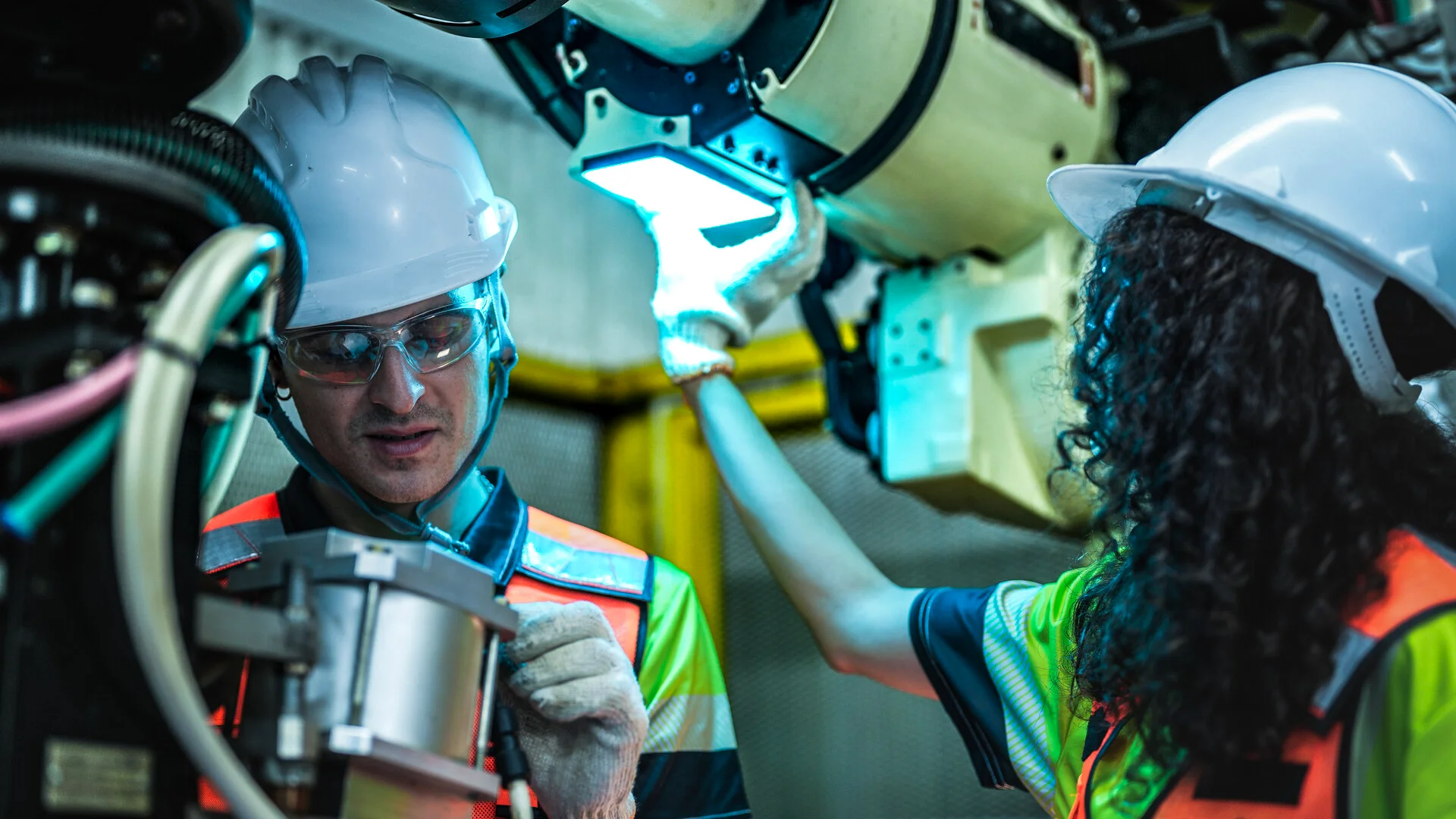
Artificial intelligence is transforming manufacturing, but bringing AI onto the factory floor requires more than digitizing records or introducing new software. Manufacturers must connect operational data, account for equipment and safety requirements, and ensure that AI solutions support the people responsible for daily production.
In many factories, information remains scattered across disconnected systems. Differences in equipment, workflows, and employee experience make it hard to share knowledge and apply consistent practices across sites. As manufacturers introduce AI into physical operations, these challenges become even more important because incorrect guidance can contribute to equipment downtime, safety risks, and production delays.
In discussions hosted by Emerj on the AI in Business Podcast, manufacturing leaders Antoine Bisson of Poka, Scot Burdette of ABB, and Jeff Witt of GE Vernova explored the practical challenges of implementing industrial AI. Their insights highlight four key strategies: building AI around physical operations, connecting relevant data, embedding assistance into frontline workflows, and standardizing deployment processes across multiple plants.
1. Designing Industrial AI Around Safety and Real-World Operations
Industrial AI differs from traditional enterprise AI because its recommendations may influence physical equipment, maintenance activities, and production decisions. As a result, safety, governance, and operational boundaries must be considered from the beginning.
Antoine Bisson emphasizes that industrial AI should deliver tangible value rather than simply introducing AI for its own sake. Systems must provide useful assistance while controlling what information they can access and what actions they are permitted to perform.
For example, an AI system might help an operator document an equipment issue, identify possible causes, or recommend troubleshooting steps. However, automatically changing equipment settings is a different level of responsibility and requires stronger controls and human validation.
Jeff Witt also highlights the importance of infrastructure. Some manufacturing equipment operates on isolated networks for security reasons, limiting its ability to communicate with external systems. In these situations, edge computing can allow AI models to operate closer to the equipment instead of depending entirely on cloud-based processing.
Manufacturers should therefore establish clear boundaries between AI assistance and autonomous execution. They must determine which tasks AI can perform independently, which decisions require human approval, and how safety requirements will be enforced.
2. Connecting Operational Data for More Accurate Guidance
AI can only provide useful recommendations when it has access to the right information and enough context to interpret it correctly.
Manufacturing environments often contain valuable data across equipment records, maintenance histories, work instructions, training materials, production systems, and safety reports. When these sources remain disconnected, workers may struggle to find the information they need to resolve problems.
Witt explains that responding to a machine alert requires more than knowing that an asset has malfunctioned. Workers also need to understand the equipment’s history, the people operating it, the work cell involved, and the upcoming production schedule.
Scot Burdette adds another consideration: customer requirements and production specifications. In manufacturing environments where products are made to order, different teams may handle successive stages of production. Each team needs access to the relevant information and must communicate essential details to the next team.
Connecting operational and business data helps employees understand how equipment conditions relate to production requirements. Training and shared knowledge are equally important because workers must be able to interpret information and apply it correctly.
Manufacturers can begin by examining a recurring operational problem and identifying the records, instructions, expertise, and production details needed to resolve it. This process can expose missing system connections and gaps in the knowledge available to frontline employees.
3. Embedding AI Into Frontline Workflows
Even a capable AI system may fail to deliver value if employees find it difficult to use. Manufacturing workers often operate under production pressure, leaving little time to navigate unfamiliar software or search through multiple systems.
Burdette highlights the importance of usability and training. Digital tools should help workers access equipment information, diagnostics, and troubleshooting guidance while performing their jobs. When additional expertise is needed, the same workflow can connect them with remote specialists.
This approach makes experienced workers’ knowledge more accessible and helps less-experienced employees learn how to handle unfamiliar situations.
Bisson describes another opportunity: simplifying issue reporting. Instead of requiring an operator to select categories, complete multiple fields, and attach supporting information manually, AI can interpret a voice description or image to help document the problem.
AI agents can also assist with follow-up activities. For example, a workflow could identify downtime exceeding a defined threshold, create an issue record, investigate possible causes, and prepare information for a supervisor. Consequential decisions would still require appropriate human review.
Witt similarly argues that AI assistance should already understand the relevant equipment and work-cell context. Workers should not have to repeatedly explain which machine they are using before receiving useful guidance.
The goal is to reduce administrative effort and information-searching time so employees can focus on evaluating recommendations and deciding what action to take.
Human oversight remains essential, particularly in maintenance. Teams must review recommendations, schedule work, arrange resources, verify tools and parts, and confirm that safety requirements are satisfied.
Feedback also matters. Recording whether recommendations were useful and documenting the results of completed work can help improve future troubleshooting and preserve valuable operational knowledge.
4. Standardizing Workflows for Scalable Deployment
A successful AI pilot at one factory does not automatically translate into success across an entire manufacturing network. Plants may use different equipment, follow different processes, and rely on knowledge that remains within individual teams.
Bisson identifies standardization as an important step after digitization. Shared work instructions, operational procedures, and skill requirements can help manufacturers reuse established practices rather than requiring each plant to develop its own solutions independently.
Witt recommends documenting and optimizing workflows before introducing AI. Automating an inefficient process may simply reproduce existing problems at a faster pace. Manufacturers should first identify unnecessary steps, eliminate waste, and establish a consistent process that can be improved and repeated.
He also describes the value of standardized asset structures. A common hierarchy can organize information from divisions and plants down to production lines, work cells, and individual pieces of equipment. Once established, this structure can support multiple applications and become more valuable as additional use cases are introduced.
Standardization, however, does not mean ignoring local differences. Equipment conditions, employee skills, and customer requirements must remain part of the decision-making context. The objective is to create reusable foundations while preserving the information needed for each plant to operate safely and effectively.
Manufacturers must also consider how solutions will be maintained after implementation. Buying an established platform and configuring it for specific workflows may be more practical than building everything from scratch, but organizations still need to account for security, governance, deployment, and ongoing support.
A scalable approach begins with one recurring workflow, prepares the process and relevant knowledge, connects the required information, involves frontline employees in testing, and evaluates performance before expanding to additional locations.
Conclusion
Industrial AI offers manufacturers opportunities to improve troubleshooting, preserve operational knowledge, support maintenance, and make information more accessible to frontline workers. However, achieving these benefits requires more than deploying an AI model.
Manufacturers must design systems around physical operations and safety requirements, connect operational data with relevant business context, integrate assistance into existing workflows, and establish standardized processes that can scale across multiple sites.
The insights shared by leaders from Poka, ABB, and GE Vernova demonstrate that successful industrial AI depends on the relationship between technology, people, processes, and operational knowledge.
The path to scalable industrial AI starts with solving a real operational problem, establishing the right safeguards, and building a foundation that workers can trust. By prioritizing practical value, human oversight, connected information, and repeatable workflows, manufacturers can introduce AI in ways that support both operational performance and long-term growth.