
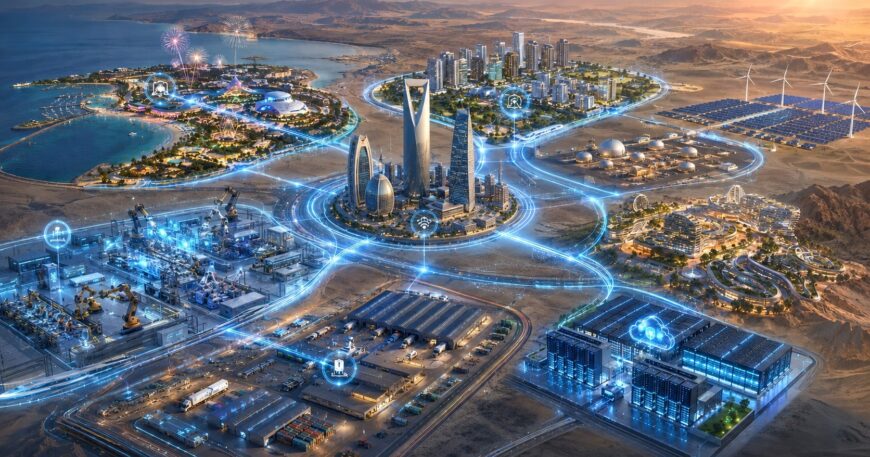
Infrastructure has developed with technology for centuries. Larger cities, longer bridges, and bigger skyscrapers were made possible by new engineering methods and materials. Infrastructure design, monitoring, and operation were later revolutionized by computing and digital technology.
Now, obstacles are emerging at the same time as the rate of change is quickening. Water, energy, and other resources are under more strain due to climate change. Engineering and design are starting to change as a result of artificial intelligence, and both new opportunities and major obstacles are being created by the technology’s energy requirements and the aging grid infrastructure. Additionally, infrastructure needs are growing, especially in developing nations, and geopolitical complexity is exposing weaknesses in global supply chains.
As a result, there is a basic problem: how can the world construct the infrastructure it requires without merely replicating the resource-intensive, carbon-intensive, and extractive model of the 20th century?
The solution, according to Ali Jadbabaie, JR East Professor and head of the MIT Department of Civil and Environmental Engineering, will necessitate reconsidering not only how infrastructure is planned and constructed but also how it is funded and run, as well as bringing together the numerous stakeholders who influence those choices. The World Infrastructure Forum, which was co-founded by UPM, the World Bank Group, the University of Texas at Austin, and MIT’s Department of Civil and Environmental Engineering, will bring Jadbabaie to Madrid on October 28 to discuss these subjects with specialists from around the globe.
Q: As technology has advanced, infrastructure has always changed. What distinguishes this age from others?
A: By constructing the dams, bridges, and canals of its era, civil engineering became the civilian equivalent of military engineering in the eighteenth century. Railroads and sewerage systems were brought about by industrialization in the 19th century. The emphasis expanded to include buildings, roads, tunnels, and metro systems in the early 20th century, and by the middle of the century, the infrastructure required to support skyscrapers and megacities.
Infrastructure has evolved with every technological advancement, including information technologies, computing, sensing, and, more recently, digital transformation. Even the definition of infrastructure has been altered by it. These days, we view the power grid, semiconductor manufacturing facilities, data centers, and wireless infrastructure—such as cellphone towers and high-speed internet infrastructure—as equally important components of our critical infrastructure as roads, water systems, and power grids.
The mix and speed of the changes we are currently seeing are different. Infrastructure design in the 20th century is under pressure from resource scarcity, climate change, and geopolitical instability. At the same time, a lot of people are escaping poverty as a result of the developing world’s recent economic expansion. In fact, estimates predict that by 2028, the median person on Earth will be able to survive on $10 per day for the first time in human history. The need for infrastructure will rise as more people escape extreme poverty.
We simply won’t have the resources to meet that demand if we attempt to do so using the same resource-intensive paradigm that we employed in the 20th century. Then, the issue arises: How can we make better use of the remaining resources? We must figure out how to build more infrastructure while consuming less energy, materials, water, and carbon.
This is where AI and digital transformation have the potential to be revolutionary. We can make infrastructure decisions more effectively with improved sensing, actuation, and control; faster and less expensive sensing; and increased data availability. AI is gradually making its way into the real world, and we anticipate that it will completely transform the engineering design process, enabling us to investigate a lot more options much more quickly and affordably.
However, the story of that has not yet been written, and depending on what we do, the results could still be quite favorable.
Could you provide an example of how infrastructure systems are becoming more integrated to the point that their construction or management is altered?
A: Over the past 30 years, the digital transformation and information technology revolution have increased the interconnectedness of infrastructure systems. This is evident in urban areas. Water and gas services, the internet, and the transportation system can all stop working if the power goes out. Numerous other services are impacted when communications networks malfunction. This was evident during COVID, when manufacturing, essential materials, and energy networks were impacted by supply chain interruptions. When oil and energy markets are disrupted by geopolitical conflicts and those disruptions spread to other areas of the world economy, we witness it.
Previously independently managed infrastructure systems are becoming more and more interdependent. Increasing systemic risk and exposing the systems to infrequent but catastrophic failures are two consequences of connecting more components for greater efficiency. They are now uncommon, but when they do occur, they are far more significant.
Developing infrastructure entails much more than just designing and constructing it, which is the really difficult part. The entire value chain encompasses funding and running it, as well as knowing who will use it and what their needs and preferences are.
Infrastructure design is therefore a highly transdisciplinary, sociotechnical undertaking that takes social, technical, and economic factors into account. Because these systems are getting more complicated and making decision-making more challenging, it is becoming more and more crucial to comprehend how they are built.
Large-scale infrastructure projects are likewise fraught with uncertainties. Projects take a long time, they require a lot of capital, and their profit margin is lower than that of many other businesses. When all of that is taken into account, the industry has historically become extremely cautious.
However, the changes brought about by AI and digital transformation may present a fresh approach. Nobody has yet to clearly define what that new approach looks like.
Q: How are you and your coworkers attempting to alter the decision-making process?
A: We came to the conclusion that no one discipline, business, or nation could create a new infrastructure strategy on its own. The difficulties are too great, and the infrastructure value chain is too interwoven.
For this reason, the World Bank Group, the Universidad Politécnica de Madrid, and the University of Texas at Austin joined forces with MIT’s Department of Civil and Environmental Engineering to co-found the World Infrastructure Forum. The objective is to establish a continuous conversation about how infrastructure should be planned, funded, constructed, and run in the coming decades by bringing together academia, business, governments, and financial institutions at all points along the infrastructure value chain.
This is especially crucial as the United States and other nations with developed infrastructure systems may not offer the greatest prospects for new infrastructure development. These nations still require substantial investment and modernization. However, a large portion of the world’s population expansion and the infrastructure that will be required over the next few decades will occur in nations with still-developing infrastructure systems.
These nations have the chance to gain from contemporary infrastructure without merely replicating the 20th-century paradigm. However, new strategies in technology, finance, engineering, and governance will be needed to seize that opportunity.
Instead of merely creating a platform, our goal is to build an ecosystem that will allow the various stakeholders in the infrastructure value chain to continue their dialog. We have formed five working groups and an advisory group comprising over thirty individuals from all sectors of the infrastructure value chain, including academia, engineering and construction, materials, finance, and multilateral institutions.
In the end, the question is not whether we require a new approach to infrastructure development. How we make it and who will carry it out are the questions. Because infrastructure is interconnected, there isn’t a single individual, organization, or nation that can address this issue. Together, we must construct the new model.