
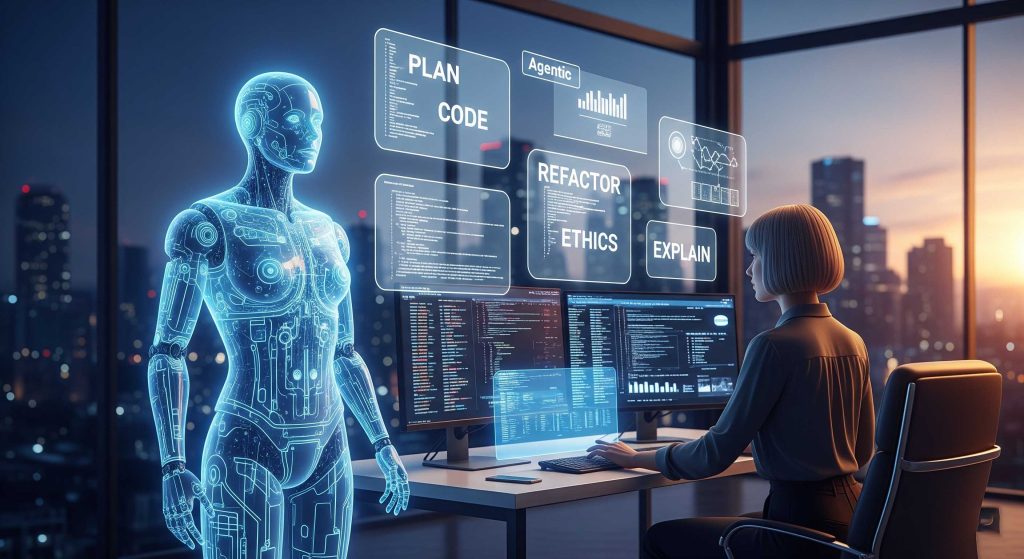
As 2026 approaches, the adoption of artificial intelligence and automation has moved beyond being a mere operational necessity to a strategic priority for businesses aiming to stay competitive. Organizational leaders are increasingly focusing on not just implementing AI automation for businesses but also integrating it in a way that enhances employee productivity, streamlines workflows, and reduces repetitive administrative tasks.
This article explores how combining AI and automation can drive higher employee engagement, optimize performance, and create a more efficient work environment.
AI-powered intelligent task routing goes beyond simple assignment by analyzing the complexity of incoming workloads, employee skill sets, current bandwidth, and historical performance. AI can assign the right task to the right person at the right time, ensuring that employees are neither overloaded nor underutilized, making work more efficient and reducing bottlenecks. Tools like Microsoft Copilot and custom Langchain agents seamlessly integrate with internal systems to facilitate this process.
This approach improves productivity through optimal task allocation that assigns tasks to employees whose skills match best, balanced workload distribution that prevents burnout, faster task completion by aligning tasks with expertise, and context-aware assignment that considers previous performance. For example, in a customer support center, an AI agent can analyze an incoming technical ticket regarding a database error and instantly route it directly to a senior engineer who has successfully resolved similar issues, skipping the general queue entirely and reducing response time significantly.
Generative AI can automatically create drafts for emails, reports, summaries, presentations, and other business content from raw data or simple prompts. With advanced AI automation for businesses, AI models like GPT-5 equivalents or Claude 3.5 enable employees to focus on higher-value activities such as strategy, analysis, and decision-making while maintaining high-quality and contextually relevant output.
However, merely accessing these tools is not enough—professionals need to master prompt engineering and understand the underlying Transformer architectures to ensure meaningful outcomes. This technology improves productivity by automating repetitive writing and reporting tasks, producing standardized content that reduces errors, enabling rapid iteration of multiple content versions, and summarizing raw data into actionable insights for faster decision-making. A financial analyst, for instance, can feed raw quarterly sales spreadsheets into an internal secure LLM that instantly produces a comprehensive draft report summarizing key trends and flagging underperforming regions.
Predictive analytics applies machine learning models to historical and real-time operational data to anticipate workload spikes, process delays, and resource shortages before they disrupt daily operations. Instead of reacting to problems after they surface, AI systems proactively trigger workflow adjustments such as reallocating resources, reprioritizing tasks, and initiating automated approvals using platforms like AWS SageMaker or Azure ML.
This approach eliminates reactive action, protects focus time by maintaining stable and predictable workflows, reduces managerial overhead, and maintains performance during peak demand periods. In a software development team, predictive analytics might identify that a testing phase is likely to fall behind due to increased defect volume and automatically adjust sprint priorities and assign additional QA support.
AI-driven meeting optimization tools automatically record, transcribe, summarize discussions, and extract action items from meetings. Platforms such as Otter.ai or Fireflies eliminate the need for manual note-taking and ensure that key decisions and next steps are captured accurately and shared with the right stakeholders immediately after the meeting.
This improves productivity by eliminating manual note-taking so employees can fully engage in discussions, creating clear accountability through automatically assigned action items with owners and deadlines, enabling faster follow-through with instantly shared meeting summaries, and reducing meeting fatigue by ensuring meetings lead to outcomes rather than just discussions. After a weekly leadership meeting, an AI tool can automatically generate a concise summary, highlight key decisions, and assign follow-up tasks to respective team members in the project management system.
Real-time AI collaboration agents act as intelligent co-workers in hybrid and remote work environments by coordinating communication, managing tasks, and automating routine collaboration workflows. Integrated with AI automation tools such as Microsoft Copilot, Slack AI, or custom workflow automation platforms, these agents ensure teams stay aligned across time zones, tools, and work schedules without constant manual follow-ups.
These agents provide instant access to information by retrieving documents and updates in real time, handle automated coordination for scheduling and status updates, and maintain stronger hybrid alignment so remote and in-office employees stay equally informed and engaged. In a hybrid product team spread across regions, an AI collaboration agent can monitor discussions in Slack, update task progress in Jira, send automated reminders via Microsoft Teams, and flag issues when dependencies are delayed.
When combining AI and automation, leaders must consider several critical factors. Data security is non-negotiable, as using public AI models for internal reports risks data leaks, requiring organizations to strictly use enterprise-grade secure environments. Companies must keep humans in the loop since AI can hallucinate or misinterpret context, making human review stages essential for accuracy and accountability.
Investment in upskilling is crucial because tools are only as good as their users, and companies must train employees on prompt engineering and AI literacy rather than assuming intuitive adoption. Organizations need to mitigate algorithmic bias by regularly auditing automated decisions, as AI models learn from historical data that may contain biases. Finally, proper integration with existing systems must be evaluated to ensure AI tools work seamlessly with current platforms and workflows without causing disruption.
As 2026 approaches, the strategic integration of AI and automation will become essential for enhancing employee productivity. By intelligently routing tasks, automating routine processes, and augmenting human decision-making, organizations will be able to unlock efficiency while empowering employees to focus on higher-value work. For leaders aiming to integrate AI and automation effectively, programs such as the Certificate Program in AI Business Strategy from Johns Hopkins offer practical guidance and strategic insights to drive productivity, optimize workflows, and make informed technology-driven decisions.