
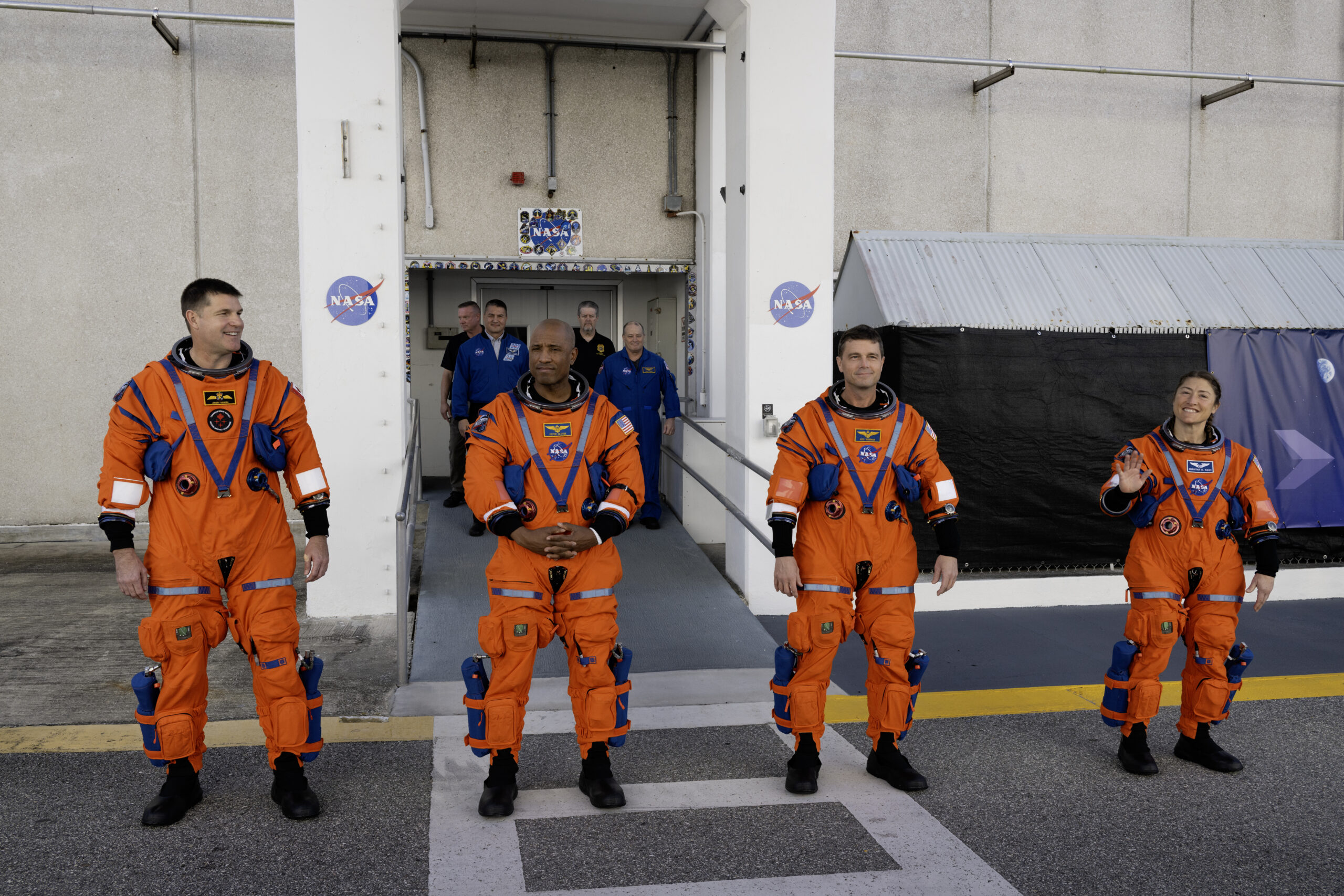
After a 10-day voyage that has yielded some of the most breathtaking space pictures since the Apollo era, the four astronauts of NASA’s Artemis II mission are only hours away from returning to Earth on Friday night. Splashdown is scheduled for 8:07 p.m. by NASA. The crew will be removed from the Orion spacecraft, which the astronauts have named Integrity, by recovery teams on board the USS John P. Murtha off the coast of San Diego.
A Rare Eclipse And A New “Earthset”
Astronauts Reid Wiseman, Victor Glover, Christina Koch, and Canadian Space Agency astronaut Jeremy Hansen took almost 10,000 pictures of the moon’s far side during the mission’s seven-hour lunar flyby on April 6. The crew exceeded the Apollo 13 record for the farthest human spaceflight, coming within 4,067 miles of the lunar surface and reaching a maximum distance of 252,756 miles from Earth.
A picture known as “Earthset,” which depicts Earth dropping beyond the cratered lunar horizon, was one among the several photos NASA released on April 7. It is a spiritual sequel to the famous “Earthrise” shot taken by Apollo 8 astronaut Bill Anders in 1968. Additionally, the crew saw and captured a total solar eclipse from beyond the moon’s far side. The sun vanished from view for almost 53 minutes, which is roughly seven times longer than any totality that can be seen from Earth’s surface. NASA also verified that during the flyby, the astronauts saw meteorites hitting the lunar surface in real time.
Koch Becomes The First Female To Travel Beyond Low Earth Orbit
During the expedition, 47-year-old Christina Koch became the first woman to travel outside of low Earth orbit. In addition to her historic role, Koch, who previously held the record for the longest single spaceflight by a woman at 328 consecutive days on the International Space Station, has garnered public notice for her life outside the astronaut corps. According to a profile released during the trip, Koch is an enthusiastic rock climber who trains on crags and freezing waterfalls in between missions.
The mission is currently in one of its most difficult stages. After reentering the atmosphere at a speed of about 25,000 mph, Orion will experience a communications blackout for six minutes before using parachutes and landing in the Pacific Ocean. NASA Associate Administrator Amit Kshatriya told the groups that constructed and managed the spacecraft at a briefing on Thursday: “The crew has fulfilled their role.” It is now our turn to fulfill ours.