
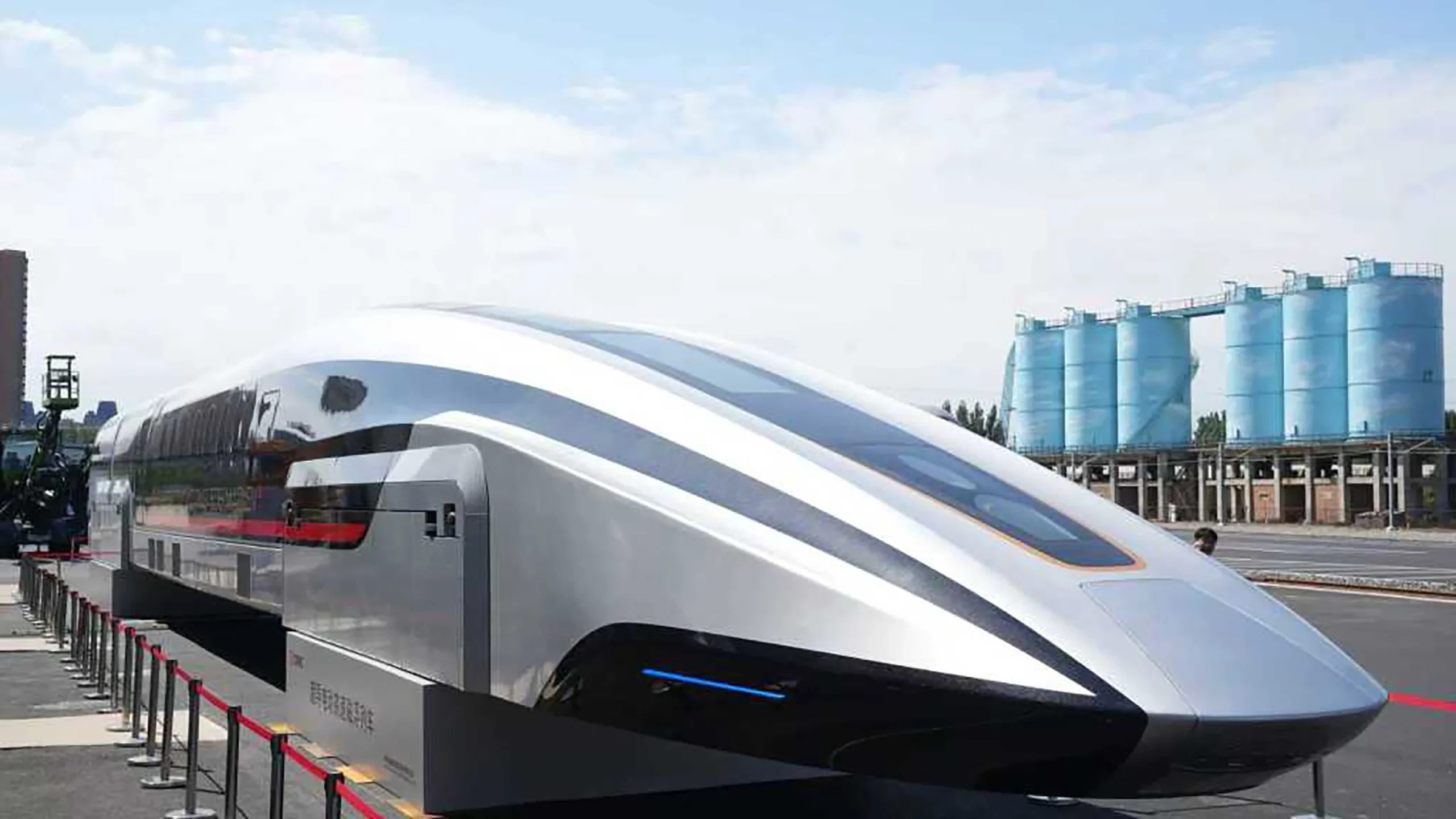
China’s transportation industry achieved a significant milestone on December 26. China’s transportation infrastructure development shows strong innovative vitality, as evidenced by the opening of the longest highway tunnel in the world, the national high-speed rail network surpassing 50,000 kilometers in operational length, and the recent maglev test vehicle breaking the speed record of 700 km/h.
In a recent magnetic levitation experiment, the National University of Defense Technology’s maglev team broke the world record for this kind of platform and achieved the fastest superconducting electrodynamic magnetic levitation test speed in history by accelerating a ton-class test vehicle to 700 kilometers per hour in two seconds.
The team made this achievement on a 400-meter magnetic levitation test line after ten years of intense investigation. Ultra-high-speed electromagnetic propulsion, electrodynamic suspension and steering, transient high-power energy storage and inversion, and high-field superconducting magnets were among the fundamental technical obstacles that this experiment overcame. “It gives China a new option for future vacuum tube maglev transportation development, offers new methods for aerospace launch assistance and experimental testing, and puts China into the international leading ranks in the ultra-high-speed maglev field,” said Li Jie, chief designer of the maglev system at the National University of Defense Technology.
The mileage of high-speed rail surpasses that of all other nations put together. China’s high-speed rail operational mileage exceeded 50,000 kilometers when the C9309 “Fuxing” intelligent EMU train left Yan’an Station at 10:00 AM on December 26, formally launching the Xi’an-Yan’an high-speed railway. This mileage is the highest in the world and surpasses the combined operational mileage of all other nations’ high-speed rail systems.
The revolutionary Yan’an base is integrated into the Guanzhong region’s “one-hour commuting circle” by the 299-kilometer Xi’an-Yan’an high-speed railway, which has a design speed of 350 kilometers per hour. China constructed and implemented 12,000 kilometers of high-speed rail during the “14th Five-Year Plan” period, a roughly 32% increase from the end of 2020. Nowadays, 97% of Chinese cities with a population of 500,000 or more are covered by high-speed rail. The “eight vertical and eight horizontal” high-speed rail network is becoming more sophisticated, with city clusters within 500 kilometers essentially forming a transit circle that takes one to two hours.
World’s Longest Roadway Tunnel Cuts Through The Tianshan Mountains
The G0711 Urumqi-Yuli Expressway, which runs through the 22.13-kilometer Tianshan Shengli Tunnel, opened to traffic on December 26. Previously requiring several hours of twisting mountain routes, this world’s longest highway tunnel connects northern and southern Xinjiang directly by passing through the central Tianshan Mountains in around 20 minutes.
The Urumqi-Yuli Expressway, which is 324.7 kilometers long and cost 46.7 billion yuan in total, took more than five years to build. According to Zhou Zheng, general manager of the CCCC Xinjiang Urumqi-Yuli Highway Project General Management Department, more than 90% of the route is made up of bridges and tunnels, and the geology and terrain are very complicated. The Tianshan Shengli Tunnel, which used independently designed Chinese equipment including the “Tianshan” and “Shengli” tunnel boring machines, employed the first “three tunnels + four vertical shafts” construction scheme in history. The trip from Urumqi to Korla will take about three hours instead of seven after it opens to traffic.