
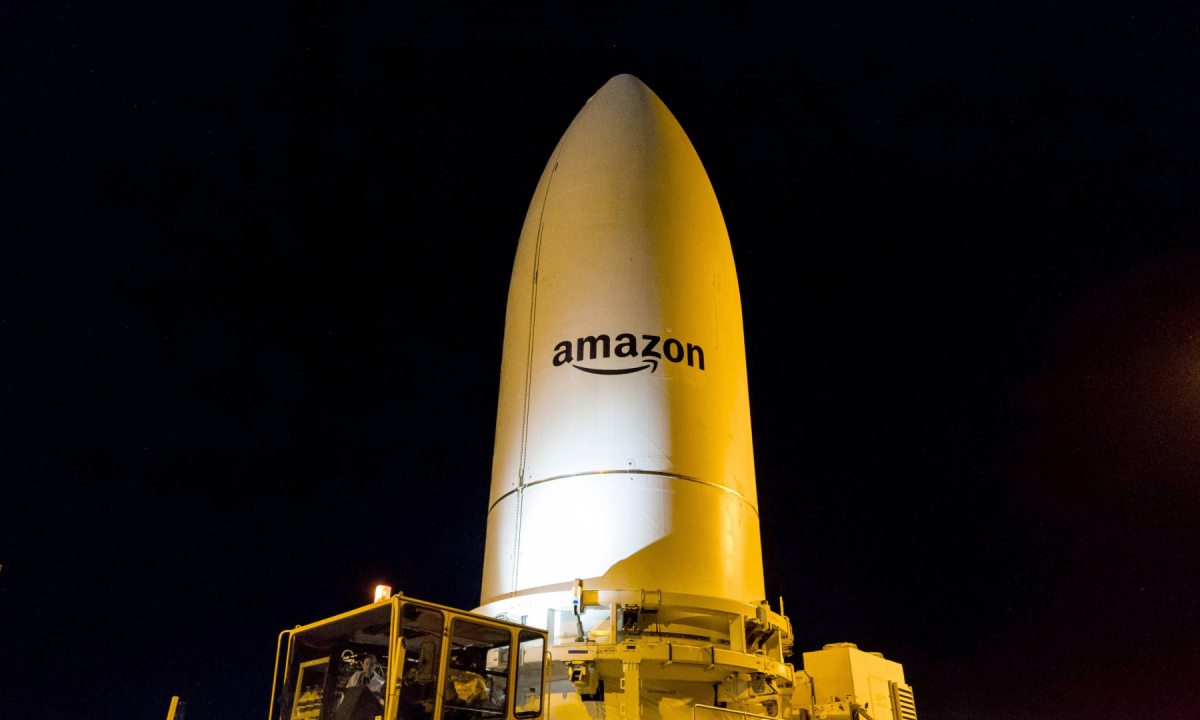
Today, April 9, marks a critical milestone in Amazon’s ambitious plan to build a global internet megaconstellation: the launch of the first major batch of Project Kuiper broadband satellites. A United Launch Alliance Atlas V rocket is set to launch from Florida’s Cape Canaveral Space Force Station, delivering 27 Kuiper spacecraft into low Earth orbit, according to sources from Space.com and Fox News.
Details Of The KA-01 Mission
At a height of 280 miles (450 kilometers) above the ground, 27 Project Kuiper satellites will be launched as part of the KA-01 mission, also known as Kuiper Atlas 1. In order to deliver high-speed, low-latency internet around the world, Amazon intends to build a constellation of more than 3,200 low-Earth orbit satellites, including these satellites. Important mission details include:
Launch vehicle: The most potent version of the United Launch Alliance Atlas V rocket, which has five sturdy rocket boosters.
Launch location: Cape Canaveral Space Force Station’s Space Launch Complex-41 in Florida.
Launch window: April 9, 2025, 7 p.m. Eastern, two hours.
Payload: The heaviest payload an Atlas V rocket has ever carried.
Satellite deployment: 280 miles in initial orbit, with plans to increase to 392 miles (630 km) in ultimate orbit.
Mission goal: Showcase end-to-end network connection and safely deploy every satellite.
With this launch, Amazon is taking the first step toward deploying their entire constellation of satellites, with plans to start providing service to consumers later in 2025.
Satellite Network In Low Earth Orbit
Low Earth Orbit (LEO) satellite networks, such as Project Kuiper from Amazon, function at altitudes of 200–2,000 kilometers. Compared to conventional geostationary satellites, these networks have the following advantages:
Decreased delay as a result of shorter signal travel distance.
Quicker internet speeds and increased data throughput.
Enhanced coverage in isolated and rural locations.
Lower launch costs and simpler replacement of satellites.
Since each satellite in a LEO constellation travels swiftly in relation to the ground, many satellites must cooperate to provide continuous coverage. With businesses like Amazon, SpaceX, and Telesat vying to establish their own LEO networks, this technology has the ability to completely transform internet connectivity worldwide.
Configuration Of The Atlas V Rocket
Using a 501 configuration, the Atlas V rocket that launches Amazon’s Project Kuiper satellites has a single-engine Centaur upper stage, a 5-meter payload fairing, and no solid rocket boosters. There are two primary stages to this configuration:
First Stage: 933,406 pounds of liftoff force are produced by a Russian-built RD-180 engine that burns kerosene and liquid oxygen.
Upper Stage: A Centaur stage with a single engine that can generate 22,290 pounds of thrust utilizing an RL10 engine that burns liquid hydrogen and liquid oxygen.
This mission is a good fit for the Atlas V 501 version, which balances cost-effectiveness and payload capacity. The absence of solid rocket boosters suggests that the payload mass is within the core vehicle’s capacity for the desired orbit, and its 5-meter fairing gives plenty of space for the 27 Kuiper spacecraft.