The “Qwen Team” of the massive Chinese e-commerce company Alibaba has succeeded once more.
Just a few days after making available for free and under open source license the Qwen3-235B-A22B-2507, the world’s best-performing non-reasoning large language model (LLM) — no joke, even when compared to proprietary AI models from well-funded U.S. labs like Google and OpenAI — this team of AI researchers has released another game-changing model.
FBI Veterans Discuss AI Cyberthreats & Upcoming Protectors
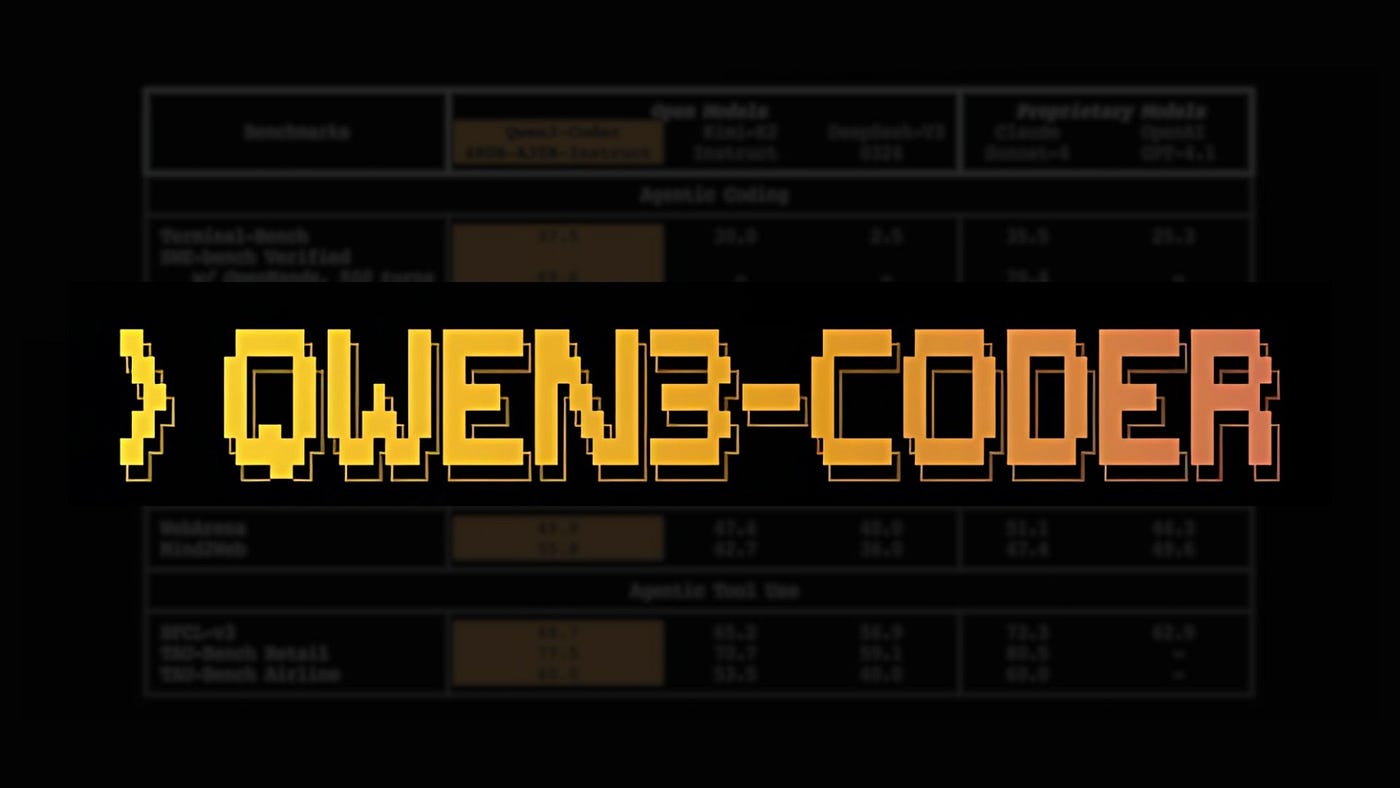
That is the new open-source LLM Qwen3-Coder-480B-A35B-Instruct, which is designed to help with software development. It can produce complete, working applications in a matter of seconds or minutes and is made to manage intricate, multi-step coding processes.
The model establishes new benchmark scores among open models and is positioned to compete with private solutions such as Claude Sonnet-4 in agentic coding jobs.
It is accessible through Alibaba’s Qwen API, Hugging Face, GitHub, Qwen Chat, and an expanding variety of third-party vibe coding and AI tool platforms.
Open Source Licensing: Flexible And Cost-Effective For Businesses
However, Qwen3-Coder, as we’ll call it, is now available under an open source Apache 2.0 license, which means that any business can use it for free, download it, modify it, deploy it, and use it in their commercial applications for employees or end users without having to pay Alibaba or anybody else a dime. This is in contrast to Claude and other proprietary models.
At least one, LLM researcher Sebastian Raschka, wrote on X that: “This might be the best coding model yet.” This is due to its exceptional performance on third-party benchmarks and anecdotal usage among AI power users for “vibe coding”—coding using natural language and without formal development processes and steps. While general-purpose is wonderful, specialization is the way to go if you want to be the best coder. No complimentary lunch.
The code is available for download on the Hugging Face AI code sharing repository for developers and businesses.
Businesses can also use the model directly through the Alibaba Cloud Qwen API if they don’t want to or can’t host it on their own or through other third-party cloud inference providers. The cost per million tokens (mTok) starts at $1/$5 for input/output of up to 32,000 tokens, then $1.8/$9 for up to 128,000, $3/$15 for up to 256,000, and $6/$60 for the entire million.
Model Capabilities And Architecture
Qwen3-Coder is a Mixture-of-Experts (MoE) model, with 480 billion total parameters, 35 billion active per query, and 8 active experts out of 160, according to the material made available online by Qwen Team.
YaRN (Yet another RoPE extrapolation) is a technique that extends a language model’s context length beyond its initial training limit by altering the Rotary Positional Embeddings (RoPE) used during attention computation. It supports 256K token context lengths natively, with extrapolation up to 1 million tokens. The model can comprehend and work with whole repositories or long documents in a single pass because to this capability.
It has 62 layers, 96 attention heads for queries, and 8 for key-value pairs. It was created as a causal language model. It streamlines its outputs by eliminating support for blocks by default and is tailored for token-efficient, instruction-following jobs.
Excellent Performance
On a number of agentic assessment suites, Qwen3-Coder has outperformed other open models.
Standard SWE-bench Verified: 67.0%, 500-turn Verified: 69.6%
54.6% on GPT-4.1
Preview of Gemini 2.5 Pro: 49.0%
70.4% for Claude Sonnet-4
Additionally, the model performs competitively on tasks including tool use, multi-language programming, and agentic browser use. In areas including code generation, SQL programming, code editing, and instruction following, visual benchmarks demonstrate steady improvement across training repetitions.
Options For Tooling And Integration
In addition to the model, Qwen has made a CLI tool called Qwen Code, which was cloned from Gemini Code, publicly available. It is simpler to incorporate Qwen3-Coder into coding workflows because to this interface’s support for function calling and structured prompting. Qwen Code is compatible with Node.js environments and can be installed from source or with npm.
Additionally, Qwen3-Coder interfaces with developer platforms like:
- Claude Code (via router modification or a DashScope proxy)
- Cline (as a backend compatible with OpenAI)
- Ollama, LMStudio, MLX-LM, llama.cpp, and KTransformers Developers can use Alibaba Cloud-hosted endpoints to connect via OpenAI-compatible APIs or run Qwen3-Coder locally.
Techniques used after training: long-horizon planning and code RL
Beyond pretraining on 7.5 trillion tokens (70 percent code), Qwen3-Coder also gains from sophisticated post-training methods:
High-quality, execution-driven learning on a variety of verifiable code tasks is the focus of code reinforcement learning, or code RL.
Long-Horizon Agent RL: Develops the model’s ability to organize, employ tools, and adjust throughout interactions over multiple turns.
This stage mimics actual software engineering problems. In order to make it possible, Qwen constructed a system with 20,000 environments on Alibaba Cloud, which provides the scale required for testing and training models on intricate workflows such as those in SWE-bench.
AI In DevOps: Enterprise Impact And Engineering Gains
Qwen3-Coder provides businesses with a highly functional, open substitute for proprietary, closed-source models. Strong outcomes in long-context reasoning and coding execution make it particularly pertinent for:
- For AI systems that need to grasp extensive repositories, technical documentation, or architectural patterns, codebase-level comprehension is ideal.
- Workflows for automated pull requests: It is appropriate for automatically creating or reviewing pull requests because of its capacity to plan and adjust over time.
- Orchestration and integration of tools: The model can be integrated with internal tooling and CI/CD systems via its function interface and native tool-calling APIs. Because of this, it is particularly feasible for agentic workflows and products, which are those in which the user initiates one or more actions that the AI model is to perform independently, on its own, and only check in when completed or when a question comes up.
- Cost control and data residency: Because Qwen3-Coder is an open model, businesses may install it on their own infrastructure, whether it be on-premises or cloud-native, avoiding vendor lock-in and having greater direct control over compute consumption.
Qwen3-Coder is a viable alternative for production-grade AI pipelines in both big tech firms and smaller engineering teams because to its support for extended contexts and modular deployment options across different dev environments.
Best Practices And Developer Access
To get the most out of Qwen3-Coder, Qwen suggests:
Temperature = 0.7, top_p = 0.8, top_k = 20, repetition_penalty = 1.05 are the sample parameters.
Maximum output length: 65,536 tokens
Transformers version: 4.51.0 or later (because of qwen3_moe incompatibility, older versions may throw issues).
Examples of SDKs and APIs are given using Python clients that are compatible with OpenAI.
When working on code generation or conversation tasks, developers can define custom tools and allow Qwen3-Coder to dynamically activate them.
Positive Initial Response From AI Power Users
After testing the model in actual coding workflows, AI researchers, engineers, and developers have given Qwen3-Coder-480B-A35B-Instruct overwhelmingly positive initial reactions.
Aside from Raschka’s admirable statement above, AI engineer and evaluator Wolfram Ravenwolf of EllamindAI talked about his experience merging the model with Claude Code on X, saying, “This is definitely the best one right now.”
Ravenwolf claimed that after experimenting with a number of integration proxies, he finally constructed his own with LiteLLM to guarantee peak performance, proving the model’s usefulness to practical practitioners who prioritize toolchain customisation.
After utilizing the model for simulation tasks, educator and AI tinkerer Kevin Nelson also provided feedback on X.
He wrote, “Qwen 3 Coder is on another level,” pointing out that the model not only ran on the scaffolds that were supplied, but also included a note in the simulation’s output, which was a surprising but welcome indication of the model’s job context awareness.
Even Jack Dorsey, the co-founder of Twitter and the creator of Square (now known as “Block”), praised the model in an X message, writing: “Goose + qwen3-coder = wow.” This was in reference to his Block’s open source AI agent framework Goose, which VentureBeat reported about back in January 2025.
These comments imply that a technically proficient user base looking for performance, flexibility, and greater integration with current development stacks is finding resonance with Qwen3-Coder.
More Sizes And Use Cases In The Future
Although Qwen3-Coder-480B-A35B-Instruct, the most potent form, is the emphasis of this release, the Qwen team says that other model sizes are being developed.
These will seek to increase accessibility by providing comparable features at a cheaper implementation cost.
As the team explores whether agentic models may iteratively enhance their own performance through practical use, future study will also look into self-improvement.