
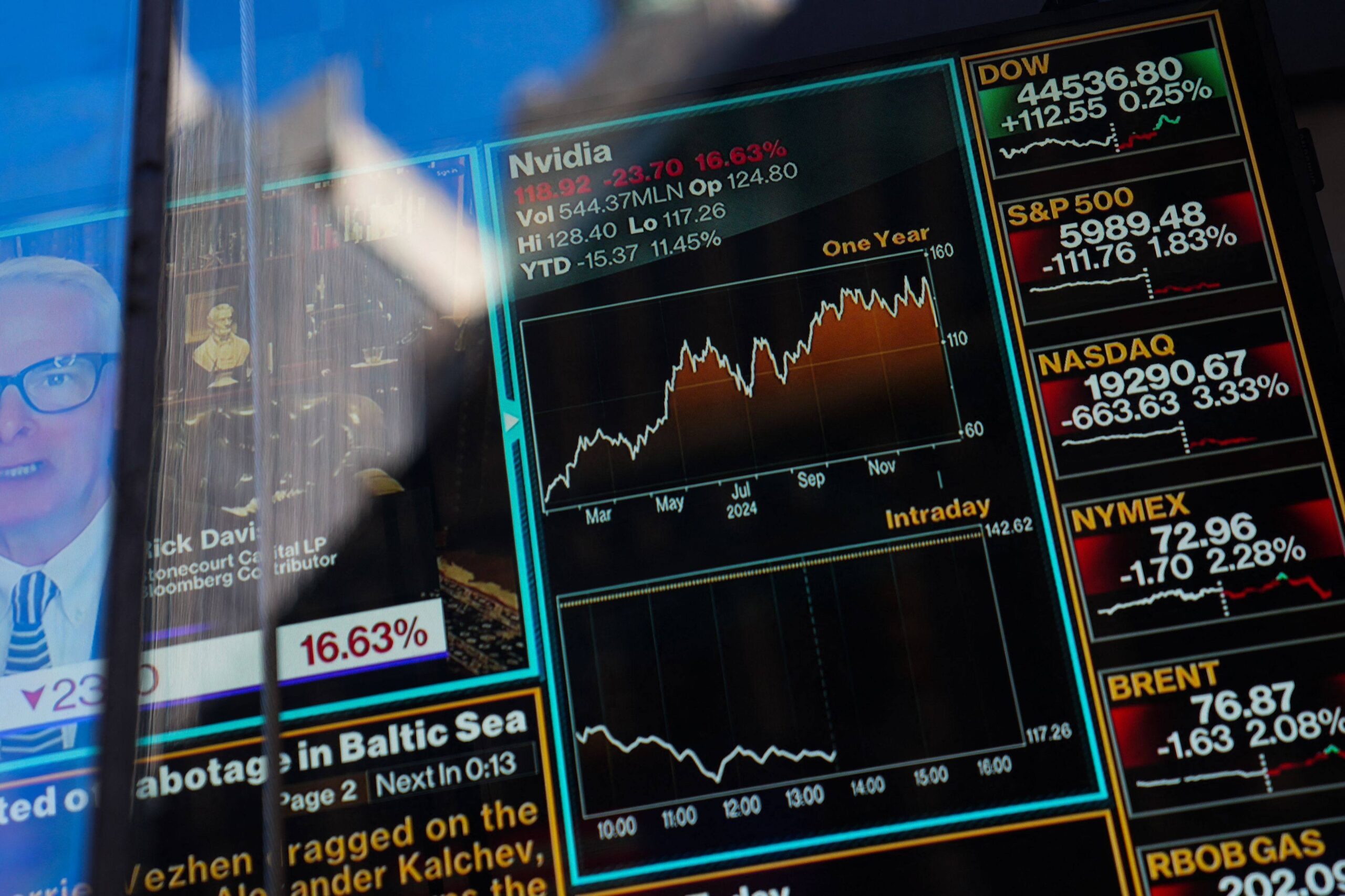
The stock markets in Hong Kong and the Chinese mainland closed down on Friday as investor confidence throughout Asia continued to be affected by a worldwide technology selloff fueled by concerns that artificial intelligence would upend established software companies.
Xinhua reports that the benchmark Hang Seng Index fell 1.21% to settle at 26,559.95 points. Now down more than 20% from its October top, the Hang Seng Tech Index, which is dominated by mainland Chinese technology companies, has plummeted for six straight sessions and into bear market territory.
The Shenzhen Component ended the day 0.33% lower at 13,906.73 points, while the Shanghai Composite dropped 0.25% to 4,065.58 points on the mainland.
Global AI Issues Drive The Selloff
The Asian drops came after a brutal week on Wall Street, when Anthropic’s Claude Cowork AI assistant saw a legal plugin launch, sending software and tech companies down. Data and legal software firms rely on the tool’s ability to automate contract evaluation, detect problems, and prepare legal remedies as their primary source of income.
Shares of data service providers fell as much as 10% after the announcement, which caused sharp losses in software firms listed in the United States. As the virus expanded to Asia, investors pulled out of technology stocks due to worries about exorbitant valuations and the possibility that artificial intelligence may disrupt long-standing business structures.
The pressure increased when Alphabet revealed intentions to spend $175 billion to $185 billion on AI computing capacity in 2026, which is almost twice as much as it spent the year before. This raised new questions about whether aggressive AI investments can be sustained.
Worries about taxes and weak U.S. job data are compounded.
Speculation of a possible increase in the value-added tax on internet services also hurt Chinese technology stocks, but Chinese officials denied the claims, saying there was “no legal or policy basis” for such increases.
Risk appetite was further soured by the disappointing U.S. employment statistics, which revealed surprisingly few job vacancies and an increase in unemployment claims, coinciding with the selloff in Hong Kong.
Similar steep drops were witnessed by South Korea’s Kospi, as foreign investors sold off almost 4 trillion won’s worth of shares in the two chipmakers, Samsung Electronics and SK Hynix.
The Future Is Still Uncertain
Instead than seeing the pullback as the beginning of a more significant collapse, other experts see it as a necessary corrective. “I see this as a healthy pullback, primarily affecting sectors that may have exceeded their fair value,” Morningstar’s Lorraine Tan stated.
“As crowded momentum trades unwind, we’re seeing pressure in software, semis, and parts of the AI ecosystem,” said Billy Leung, an investment strategist at Global X Management, while others maintained their caution.