
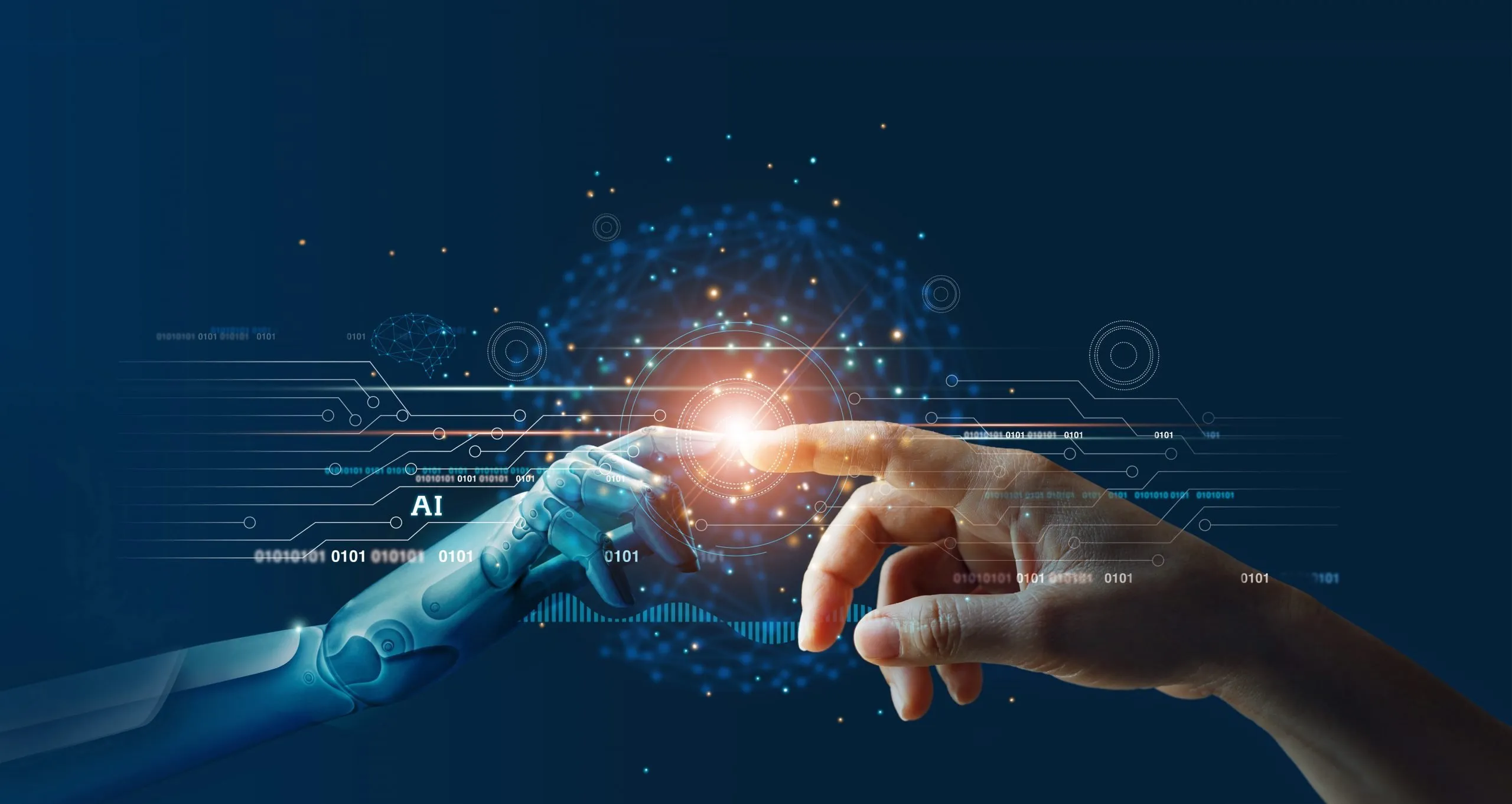
Artificial intelligence is changing the way we live, work, and create; it is no longer science fiction. This article examines AI’s background, practical applications, moral dilemmas, and potential to address world issues in the future.
Artificial Intelligence’s Future
Imagine a world in which robots are able to understand, learn, and adapt in addition to keeping records; this is not fiction anymore; artificial intelligence is becoming a reality. AI-based technology is revolutionizing work, life, and connectivity, whether it is used in voice assistants, driverless cars, or several other applications.
Intelligent systems that mimic human intelligence in their ability to learn, solve problems, and make judgments are referred to as artificial intelligence (AI). But within a few decades, artificial intelligence (AI) become a vital tool in practically every sector. AI is expected to transform society in all four quarters in unprecedented ways in the future thanks to more intelligent algorithms and bigger information.
This essay explores how the AI revolution will alter how we think ethically, conduct business, provide healthcare, and teach. In order to build a more intelligent, less prejudiced future, we must become acquainted with the potential and constraints of artificial intelligence in light of this digital frontier.
An Overview Of AI’s Past And Present
When Alan Turing and John McCarthy started their research in the 1950s, artificial intelligence history began. Once constrained by computing power, AI advancements gained impetus in the 2000s thanks to sophisticated algorithms and huge data.
While early limited AIs dealt with tasks like spam detection, modern generative AI, like ChatGPT, can produce code, artwork, and content.
Examine the ways that generative AI is changing several industries.
Voice assistants, self-driving cars, and advertisements are just a few examples of how artificial intelligence (AI) has permeated every aspect of our daily lives and profoundly altered how we work and live. The line separating human and machine intelligence is becoming increasingly blurred.
AI In The Economy And Industry
AI advancements are revolutionizing and upending the economy and industries.
Automation and Labor Markets: Routine jobs can be completed more quickly and precisely by AI-powered software and robots than by people.
Although efficiency is increased, certain industries experience job displacement as a result.
Manufacturing: AI makes performance monitoring and predictive maintenance possible.
It facilitates supply chain operations and offers real-time quality assurance.
Logistics: Delivery routes are optimized using intelligent routing systems.
Automation in warehouses boosts productivity and lowers expenses.
Finance: AI is applied to risk analysis, algorithmic trading, and fraud detection.
It makes individualized financial and banking services possible.
AI is changing how American banks perceive their customers.
Agriculture: AI supports soil health evaluation, crop monitoring, and predicted yield analysis.
Farming machines that operate autonomously are more productive and need less manual effort.
Innovation-Propelling AI Startups
Innovation has increased quickly as a result of the rise of AI startups. Startups are upending established business models and exploring new markets by using AI to improve diagnostic efficiency, fintech companies developing more creative credit scoring systems, or health tech companies doing the same. Become proficient in artificial intelligence to join this innovative wave.
AI’s Impact On Legacy Sectors
The legacy industries are undergoing a transition as well. By optimizing their processes or making critical decisions based on data, the same companies who have integrated AI into their operations are gaining a competitive edge.
In the same way that the world economy was about to undergo another industrial revolution in which machines would replace humans, it is currently about to undergo another industrial revolution, this time driven by intelligent systems rather than mechanical ones.
Through automation, intelligent decision-making, and predictive analytics, artificial intelligence is already changing sectors including manufacturing, logistics, and finance.
Practical artificial intelligence projects that show how these technologies are used in actual commercial settings are available for you to examine.
AI In Daily Life
Artificial intelligence is becoming more smoothly incorporated into daily life. Real-time scheduling, reminders, and response are all tasks that Siri, Alexa, and other smart assistants can complete. While predictive algorithms anticipate our requirements in apps, commerce, and navigation, we receive individualized recommendations for what to read, buy, and look at.
In the medical field:
AI speeds up drug research, predicts patient outcomes, and improves diagnostics by analyzing medical imagery. Virtual health assistants provide round-the-clock care and insights to enhance the management of chronic conditions and mental health.
Regarding Education:
Learning gaps are reduced by using AI-driven adaptive learning systems to provide individualized instruction based on each student’s unique needs. AI tutoring programs are available that provide practice problems, instant answers, and even simulate one-on-one instruction.
In our daily lives, AI is redefining accuracy, convenience, and personalization. These technologies gather more data as they grow more intelligent and predictive, enticing us into a hyper-networked, artificial intelligence-enhanced world.
Risks And Difficulties In Ethics
Despite its enormous potential, artificial intelligence also raises serious ethical concerns and risks. One major concern is algorithmic bias, which includes the possibility of consistently promoting prejudice in financing, hiring, and law enforcement—all of which are facilitated by AI systems that have been trained on biased datasets.
Fairness in AI requires the fulfillment of responsibility in outcomes as well as transparency in model creation.
Data privacy is another high-priority problem. Since AI mostly relies on personal data, user data could be misused or handled improperly in the absence of the required security measures.
Another problem is the lack of cross-border uniformity in privacy procedures, which makes individual rights protection challenging.
AI technology is threatening to widen social inequality and has already resulted in job displacement in low-skilled industries. Even if new AI-related jobs are being created, the reskilling program needs to be scaled up significantly to prevent economic disruption.
Autonomous weapons and the misuse of AI to propagate false information, including deepfakes, pose more dangerous risks. In addition to endangering people, these also pose a threat to democratic regimes and international stability.
Additionally, there are regulatory gaps that point to chances for AI to be used in industries like finance and surveillance without adequate oversight.
Governments, businesses, and scientists must work together to create ethical frameworks for AI, properly regulate it, and give human-centric design top priority in order to guarantee a safe and just future. Handling these risks is as important as developing the technology itself. To learn more about these concerns, enroll in a free course on the moral uses of AI.
The Future: What Will AI Do Next?
The future of artificial intelligence is a topic that both excites and worries us. Artificial General Intelligence (AGI), or AI that equals or surpasses human cognitive capacities, is a major topic of conjecture. AGI is seen as a far-off, potentially unachievable objective by some academics, while others think it could appear within decades. The discussion emphasizes the necessity of robust ethical and governance structures, regardless of whether it is genuine or hype.
Collaboration between humans and AI has the most promise in the near future. AI is positioned to enhance human capabilities rather than replace them, assisting researchers with intricate modeling and simulations, allowing creatives to create content more quickly, and assisting physicians with data analysis. The co-evolution of machine and human intelligence has the potential to revolutionize creativity and productivity in all domains.
Beyond specific businesses, AI can assist in addressing global issues. AI has the potential to significantly improve food distribution, advance disease research, forecast climate trends, optimize energy infrastructures, and solve issues that have long defied conventional methods.
However, responsible innovation is essential to this future. Cooperation between technologists, legislators, and the general public will be crucial as AI develops to guarantee that its advantages are widely distributed and its drawbacks be kept to a minimum. The values we decide to instill in algorithms will also have a significant impact on the next phase of AI.
Artificial intelligence is a defining feature of the twenty-first century, not only a technical advance. From its humble beginnings to the emergence of generative AI, the technology has swiftly spread from labs into every sphere of daily life, revolutionizing economies, industries, and individual lives.
As we’ve seen, AI has a wide range of promise, from transforming how we work and solving global issues to enhancing healthcare and education. However, it also presents important societal and ethical issues that require serious consideration.
The way forward is about what AI should do, not merely what it can do. Whether AI is a force for empowerment or divisiveness will depend on the decisions we make today on regulation, transparency, and inclusivity as we enter this new era.
AI’s future is still being shaped. Let it be a tale of ethical innovation, where technology advances rather than supplants humans.