
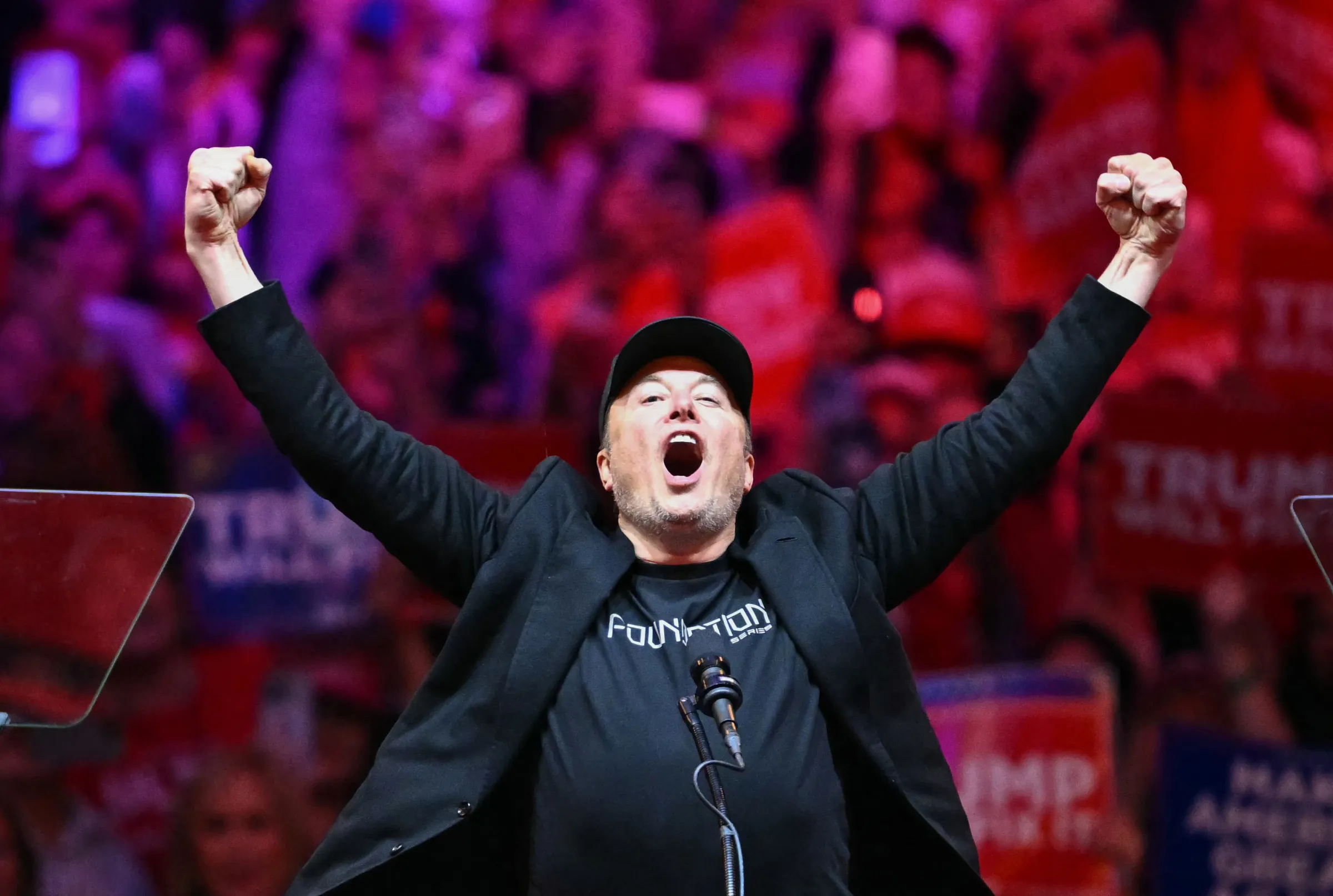
This election, Elon Musk, the wealthy CEO of SpaceX, Tesla, and xAI as well as the owner of The Boring Company, Neuralink, and X, made a dramatic rightward shift in favor of Donald Trump. He used his enormous wealth, power, and X megaphone to sway the election’s outcome.
Musk’s backing is a break from the executive’s previous connection with Trump, and it came despite Trump’s anti-EV and climate change pessimism. Musk protested Trump’s decision to pull out of the Paris Climate Accords by leaving both advisory committees he served on during Trump’s first term.
With a net worth of over $260 billion and a donation of over $100 million to a pro-Trump super PAC, Musk is now in a position to become the most powerful business and political advisor to the incoming president. When Trump visited the Economic Club of New York in September, he assured Musk that he would be the head of a new Department of Government Efficiency.
(In reference to his joke cryptocurrency, Musk has given the unestablished department the moniker DOGE, which has caused the coin’s market valuation to increase by more than 6% in the past day.)
The billionaire executive’s position might allow him to suggest significant cuts to what he views as a “vast federal bureaucracy…holding back America in a big way.”
Trump acknowledged his largest donor during his victory address, referring to him as a “super genius” and saying, “We need to protect our geniuses.” Separately, Trump declared Tuesday evening, “Elon, a star is born.”
Even if only a portion of Musk’s plans for DOGE materialize, it could be one of the most significant examples of a businessman influencing the laws and policies that control his companies. Many have predicted that the two powerful figures will clash before Trump’s four-year term is up.
Reducing Government Spending By Applying The Tesla Model
Musk may at least assert that he has been successful in his undertakings, even as Trump has mostly used his reputation as a successful businessman to achieve power (X notwithstanding). Former Tesla president Jon McNeill claims that this is because of a formula that emphasizes innovation by subtraction and drastically simplifying issues.
This entails actions like automating workflows, challenging every requirement, and eliminating every stage in the process before adding it back in. If Musk is appointed to his promised position, which would entail carrying out a “complete financial and performance audit of the entire federal government and making recommendations for drastic reforms,” as Trump stated in September, we should anticipate that he will adopt a similar stance toward government spending.
While livestreaming a Q&A while flying on a private aircraft from Texas to witness the election results with Trump at Mar-a-Lago on Tuesday night, Musk said that he would try to reduce the size of all federal agencies.
Musk claimed that there was a great deal of duplication of effort and that several agencies’ responsibilities overlapped. “There are many government employees who simply need to be moved to more productive positions in the private sector.”
Musk proposed paying government workers for two years while they looked for other employment and stated that layoffs would be implemented “humanely.” He also considered giving bureaucrats term limitations.
“Regulations must be necessary; we still want to see them,” he stated. “I compare it to field referees.” While having more officials than players is undesirable, having no refs is also undesirable. That is absurd.
How Tesla Might Be Affected By A “EV Mandate”—Or None At All?
Throughout many administrations, the government has provided support to Musk’s companies. Most recently, Tesla benefited from the Inflation Reduction Act of the Biden Administration, which offered EV tax credits to purchasers and hundreds of billions in subsidies for investments in renewable energy projects.
In 2024, Tesla made over $2 billion from the sale of clear air credits to other cars in accordance with EPA regulations.
It is now anticipated that Trump, who has previously discussed repealing a nonexistent “EV mandate,” will reverse several of Biden’s EV plans. Given that many of its competitors are still attempting to catch up to it, it might be even more good news for Tesla if he removes subsidies for EVs.
“In a non-subsidy environment, Tesla’s scale and scope are unrivaled in the EV industry, and this dynamic could give Musk and Tesla a clear competitive advantage,” Wedbush analyst Dan Ives stated.
On Wednesday, Tesla’s stock is up over 15%.
Speeding Up SpaceX’s Mars Expedition
The Trump administration is also advantageous to SpaceX. During his first term, Trump reestablished the National Space Council for the first time in 24 years and stood up the U.S. Space Force, among other significant changes to U.S. space policy. America’s space ambitions, particularly Artemis, its flagship mission to send humans back to the moon, are not expected to undergo any significant adjustments. However, the Republican Party platform for 2024 made it clear in a succinct paragraph that America should be at the forefront of the space industry, sending humans “back to the moon, and onward to Mars.”
The amount of space exploration that Trump has discussed has increased dramatically in recent weeks. He endorsed SpaceX’s crewed flights to Mars during a rally on October 24, saying, “We will land an American astronaut on Mars.” Elon, thank you. Elon, hurry up and start that spaceship. He expressed his desire “to reach Mars before the end of my term” in a different address.
An uncrewed mission to Mars could happen before the end of this second Trump term, as the next Earth-Mars transfer opportunity is in 2026. Given the time Musk and Trump spent together during the campaign, it’s probably no accident that Musk’s most recent announcement of SpaceX’s intentions for the Red Planet is this: “The first Starships to Mars will launch in 2 years…”The first crewed flights to Mars will be in four years if those landings go well,” he stated on X.
The Federal Aviation Administration, which oversees commercial launches in the US, may need to make adjustments in order to meet those deadlines. Due to the FAA’s alleged incapacity to keep up with the rate of commercial innovation, SpaceX has been engaged in a verbal sparring match that has become more public. Musk’s planned Department of Government Efficiency may target the agency’s “superfluous” delays, as SpaceX described them in a recent blog post.
Musk is not the only space billionaire who is keen to establish ties with the president; at the end of October, Jeff Bezos’ Blue Origin had a visit from Trump. (The Washington Post, which Bezos owns, declared that day that it would not support a presidential candidate for the first time in its existence.)
X And XAI
The implications of Trump’s victory are less evident for X, the social networking platform that Musk owns, and xAI, his fledgling artificial intelligence business, though Musk has already started to make predictions about possible repercussions.
Since Musk took ownership, more than 200 sponsors, including Apple, Disney, IBM, Paramount, and Sony, have ceased to run ads on X. Now that Trump has been elected president, Musk believes things will alter.
According to a recent worldwide survey by market research company Kantar, 26% of marketers intend to cut back on their X investment in 2025 because they are worried that the platform’s extreme material would harm their brands. Nevertheless, Musk stated, “I think if Trump wins, we’ll see probably most of the boycott lift,” during his recent interview on the Joe Rogan Experience podcast.
A number of regulatory investigations have been focused on X, including one from the regulatory Trade Commission, which looked into the platform’s privacy policies under Musk, a practice that FTC Chair Lina Khan has publicly criticized. Musk declared in late October that “she will be fired soon.”
Over the years, Musk has also faced off against the Securities and Exchange Commission. Regarding Musk’s acquisition of Twitter stock and his statements regarding his investment in the company, the government filed a lawsuit against him last year and attempted to subpoena him. In response, Musk demanded a “comprehensive overhaul” of the SEC.
Meanwhile, the Trump administration’s lack of regulation of AI may help Musk’s AI startup, xAI, which is reportedly looking to raise several billion dollars on top of its previous $6 billion Series B at a $40 billion valuation. According to experts, they anticipate that Trump will take a light-touch approach to regulation, depending on current rules rather than enacting any new ones.
According to Matt Mittlesteadt, a research fellow at George Mason University, trade policies may have the largest influence on AI. The AI industry may be impacted financially by Trump’s planned 10% tariff on all U.S. imports and 60% tariff on goods created in China.